
Our product rankings are based on analysis of thousands of customer reviews, brand reputation, pricing trends, and popularity data. They represent our honest opinion and are intended as a helpful starting point for your research. Some links on this site are affiliate links — if you buy through them, we may earn a small commission at no extra cost to you. This helps us keep the site free and up to date.
 Waterdrop T4-A Alkaline pH+ Reverse Osmosis Water Filter
 Waterdrop T3-C Tankless Reverse Osmosis System (8-Stage, 450 GPD)
 Cellthyhomes S01 Reverse Osmosis Water Filter (800 GPD, Tankless)
 Waterdrop CoreRO WD-C1SL (Alkaline Mineral, 7-Stage)
 Ispring RCC7AK-BLK (6-Stage, 75 GPD, Black Faucet)
 Waterdrop G5P500A Alkaline Mineral pH+ Reverse Osmosis Water Filter (8-Stage, Tankless)
Waterdrop is a water filter brand sold in the UK through its own store and on Amazon. Its reverse osmosis range covers two very different kinds of product, and knowing which one you want saves a lot of comparing.
Every Waterdrop RO system works the same way at its core:
The two families are:
A reverse osmosis water filter goes much further than a jug water filter or a carbon-only filter, because the filtration happens at a molecular level. Between Waterdrop's own listings and independent lab tests, the list covers:
The best check on these claims is independent certification. NSF/ANSI 58 covers reverse osmosis performance (TDS and the contaminants above), NSF/ANSI 42 covers chlorine, taste and odour, and NSF/ANSI 372 confirms the materials are lead-free. The G3P600, X12 and X16 hold all three.
Every figure below comes from the manufacturer's listing in our product feed. Output is in US gallons per day at full flow; divide by about 380 for litres per minute.
| Model | Type | Output / tank | Stages | Pure : drain | Worth knowing |
|---|---|---|---|---|---|
| G3P600 | Plumbed in, tankless | 600 GPD | 8 | 2:1 | Smart faucet with TDS, NSF 42, 58 & 372 |
| G2P600 | Under sink | 600 GPD | 7 | 2:1 | Two filters only, under 55dB |
| G5P500 / G5P500A | Plumbed in, tankless | 500 GPD | 7 / 8 | 2:1 | 14.5cm wide; A version adds minerals and a TDS meter |
| T3-C / T3-M | Cupboard or wall | 450 GPD | 8 / 9 | 2:1 | One all-in-one cartridge, auto flush; M adds minerals |
| T4-A | Under sink | 450 GPD | 10 | 2:1 | Dual stream: plain RO and alkaline from one faucet |
| X8 | Under sink | 800 GPD | 9 | 2:1 | Takes tap water up to 1,000 ppm TDS |
| X12 | Plumbed in, tankless | 1,200 GPD | 11 | 3:1 | UV and alkaline minerals, NSF 42, 58 & 372 |
| X16 | Under sink | 1,600 GPD | 11 | 3:1 | 18-layer membrane, energy-saving mode |
| A2 / A2G | Countertop | 1.1L jug | 6 | 3:1 | Hot and cold water, 15-95°C; A2G remineralises |
| K19-H / K19-HG | Countertop | Instant hot | 5 / 7 | - | 45-95°C in 5°C steps, UV; HG adds minerals |
| C1H | Countertop | 3.2L tank | 6 | 3:1 | Instant hot up to 85°C, five settings |
| C1SL | Countertop | 5L tank | 7 | 3:1 | Alkaline minerals, no heater, NSF 58 & 372 |
| M1 | Countertop | 4.5L, glass jug | 6 | 3:1 | Seven temperature settings |

If you drink a lot of filtered water, cook with it or fill bottles every day, an under sink reverse osmosis system makes more sense than a jug or dispenser. Drinking water comes from its own faucet whenever you want it and there is no tank to refill.
The Waterdrop G3P600 is the model most UK buyers end up with. It makes 600 gallons a day (roughly 0.42 gallons a minute, enough to fill a glass in about eight seconds), wastes one cup for every two it makes, and the housing is only 14.4cm wide. Its faucet shows the TDS reading of your filtered water and how much filter life is left.
The cheaper Waterdrop G2P600 makes the same output with two filters rather than three and a plain faucet. If you don't want the readouts, the G2P600 is the simpler reverse osmosis system and the cheaper one to run, though it is out of stock at the moment. The G5P500 is a compact 500 GPD option, and the G5P500A adds a mineral stage.
Waterdrop also sells the Waterdrop G3P800, a faster version of the G3P600 at 800 GPD with a UV sterilising light and a 3:1 pure to drain ratio. It uses the same CF and CB replacement filters as the G3P600, so spares are easy to find. Choose the G3P800 over the G3P600 if more than two or three people drink from it.
The X8 (800 GPD, nine stages), X12 (1,200) and X16 (1,600) are Waterdrop's flagship reverse osmosis systems. The X12 and X16 move to a 3:1 ratio, which matters if you are on a water meter. The X12 adds UV and alkaline mineralisation. They are bigger units, so measure your cupboard before ordering.
For a family that uses RO water for cooking, coffee machines and pets, the extra speed is noticeable. For one or two people a G3P600 is plenty.

The T3-C, T3-M and T4-A make 450 GPD and use a single all-in-one cartridge, which makes filter changes as simple as they get. The T3-C can be wall mounted as well as sat in the cupboard. The T4-A has a dual-stream faucet that gives you plain RO water or alkaline water from the same spout.
The K6 is Waterdrop's plumbed-in system with instant hot water, at 600 GPD. It's the one to look at if you want filtered hot and cold water but have no room on the worktop for a countertop dispenser.
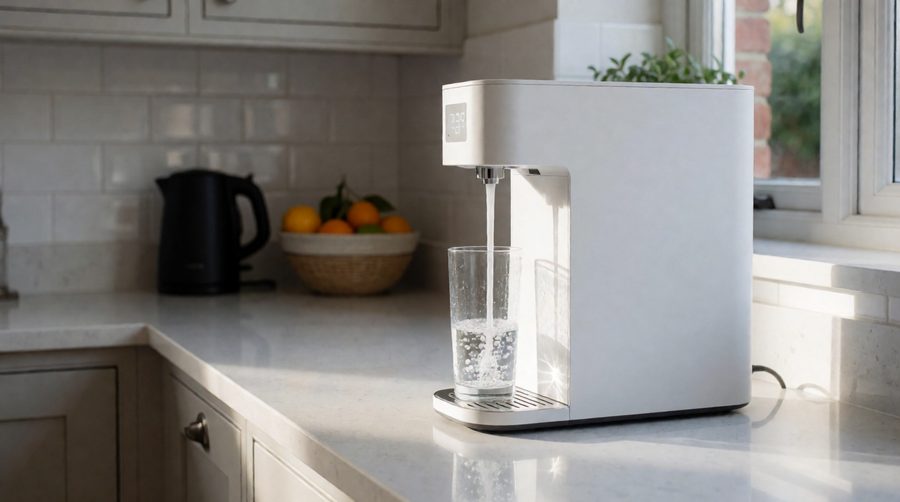
A countertop reverse osmosis system is the answer if you rent, can't drill the worktop or just don't want to touch the plumbing. You fill the tap water tank, plug it in and it filters into a clean tank. The downsides are that you refill by hand every day or two, empty or flush the waste, and it takes up worktop space.

For other brands that need no fitting, browse all our countertop reverse osmosis systems, or for caravans and moving house look at portable RO units.
| Under sink (G, X, T) | Countertop (A, K19, C1, M1) | |
|---|---|---|
| Installation | Cold feed, drain saddle, faucet hole, socket | None - fill and plug in |
| Supply | Unlimited, on demand | A tank at a time |
| Hot water | K6 only | Most models |
| Space | Inside the cupboard | On the worktop |
| Renters | Ask the landlord first | Ideal |
| Filters | Two or three, staggered | Usually one composite |
If you need lots of filtered water and own your home, plumb one in. If you want hot water for tea or can't fit anything, go countertop.
For one or two people, 450-600 GPD is enough. For a family, or if you fill large pans and bottles, 800-1,600 saves waiting. Cold winter mains water slows any RO filtration, so treat the rating as a best case.
The G and T series make two litres of filtered water for every litre sent to drain; the X12, X16 and countertop units manage 3:1. Older tank systems often waste far more. On a meter, the higher ratio is cheaper to run.
Reverse osmosis strips calcium and magnesium along with the contaminants, so the water can taste flat. Models ending in A, M, SL or G (A2G, K19-HG, C1SL, G5P500A, T3-M, T4-A, X12) add minerals back after the RO stage.
Only the countertop models and the K6 heat water. If you want filtered water near boiling point for tea, the K19 and A2 reach 95°C; the C1H tops out at 85°C.
Check the maximum input TDS. The G3P600 and T3-M accept up to 300 ppm, the X8 up to 1,000 ppm and the A2 up to 2,000 ppm. Very hard water wears filters faster.
Countertop units use one composite filtration cartridge, usually changed about every 12 months. Under sink models have two or three, each on its own schedule:
All of them twist out in a few seconds without tools, and the faucet or display tells you when one is due. Waterdrop sells each replacement filter on its UK site as well as on Amazon; check what a year's filters cost before you buy the system.
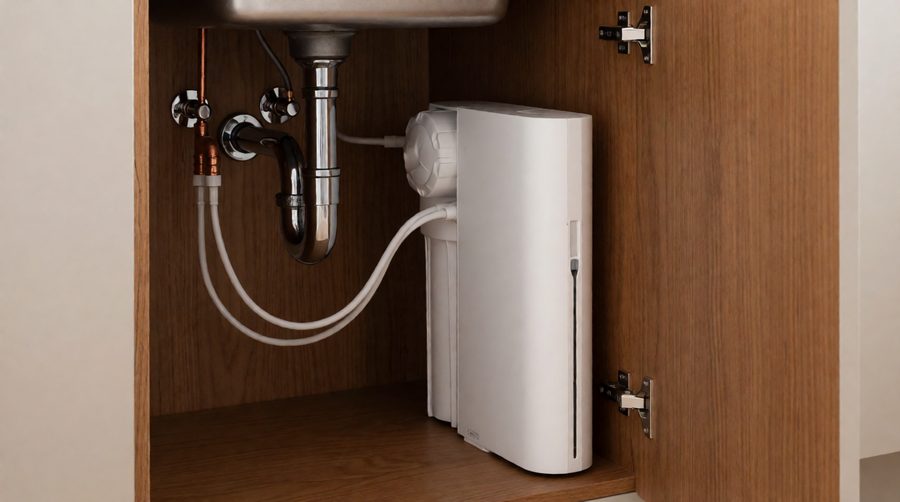
A plumbed-in unit needs a cold feed, a drain saddle on the waste pipe, a socket in the cupboard and a hole for the faucet in the sink or worktop. The T3 and T4 listings say drilling is required. In the UK any fitting connected to the mains must meet the Water Supply (Water Fittings) Regulations 1999, and WRAS lists approved fittings and installers. Confident DIYers manage the installation in an hour or two; otherwise book a plumber.
Much of England has hard water. Because reverse osmosis filtration removes the dissolved calcium and magnesium that form scale, RO water stops the white crust in kettles and coffee machines and gives clearer tea and better taste. Do read the Drinking Water Inspectorate advice before you buy: it notes that RO changes the natural properties of tap water and can waste 20-30% of the water fed in, and it stresses changing cartridges on time so bacteria can't build up. A mineral stage and keeping to the filter schedule answer most of that.
Waterdrop's UK store and resellers list a 12-month manufacturer warranty on systems such as the G3P600 and A1; check the listing for your model. On Trustpilot, many reviews praise Waterdrop's customer service for sending replacement cartridges and sorting faults quickly, even after the warranty has run out.
Waterdrop's strengths as a water filter brand are compact under sink units, tool-free twist-in filters and a wide countertop range. iSpring reverse osmosis systems and APEC RO systems lean towards traditional tanked setups that work without electricity. Frizzlife competes closely with the G series, and AquaTru countertop filters are the main rival to the A2 and C1. To pick by filtration depth, see our 7 stage RO systems and 8 stage RO systems.
Its best sellers have plenty of reviews: the G5P500 sits at 4.6 stars from over 1,000 Amazon ratings and the Waterdrop G3P600 at 4.5 from more than 500. Several models carry independent NSF/ANSI certification.
Yes, a Waterdrop reverse osmosis system reduces fluoride along with lead, arsenic, nitrates and dissolved solids. The K19-HG and A2 listings name fluoride specifically.
Yes. The under sink models use a pump, so you need a socket in the cupboard, and countertop units plug in. No power means no filtered water until it's back.
Typically the pre-filter every 6-12 months and the membrane every 24 months on plumbed-in models, and one filter about every 12 months on countertop units.
The G3P600 and G5P500 are only around 14.5cm wide. With no cupboard space at all, the K19-H is one of the smaller countertop units at 20.1cm wide.
Some plumbed-in models can, with Waterdrop's small pressure tank kit sold separately. Check the listing for your model first.
