
Our product rankings are based on analysis of thousands of customer reviews, brand reputation, pricing trends, and popularity data. They represent our honest opinion and are intended as a helpful starting point for your research. Some links on this site are affiliate links — if you buy through them, we may earn a small commission at no extra cost to you. This helps us keep the site free and up to date.
 HBN Hot & Cold Countertop Reverse Osmosis Water Filter System (Model CP-UTJ-W52C)
 Vortex Air H2 Oasis (Black, Countertop RO System)
 Langwater TheWell 2 Reverse Osmosis Water Filter (Peach, Countertop)
 Waterdrop CoreRO WD-C1SL (Alkaline Mineral, 7-Stage)
 Waterdrop G3P600 Reverse Osmosis (600 GPD, Under Sink)
 Ciarra SusGreenable Reverse Osmosis System Countertop (Black, Instant Hot Water)
Countertop reverse osmosis systems give you RO-purified drinking water from a unit that sits on the worktop and plugs into a normal socket. You fill the feed tank from the tap, and a 0.0001 micron membrane strips out lead, chlorine, fluoride and most dissolved solids before the water reaches your glass.
They suit renters, small kitchens and anyone who wants purer water for tea, coffee and cooking without drilling the sink. Many double as an instant hot water dispenser. Prefer a permanent fit? Compare our tankless reverse osmosis systems for under the sink.


A countertop reverse osmosis system is a self-contained water purifier about the size of a coffee machine. Instead of being plumbed into the cold mains under the sink, it has its own feed reservoir: you top it up with tap water, a small pump pushes it through each filtration stage, and purified drinking water collects in a jug or glass carafe. The rejected water, carrying the concentrated salts and impurities, goes into a separate compartment that you empty down the sink. No plumbing, no drilling and no installation fee.
The heart of every model is the RO membrane, a semi-permeable sheet with pores of around 0.0001 microns. Water molecules pass through; dissolved solids, heavy metals such as lead and arsenic, fluoride, nitrates, bacteria and most PFAS do not. Around it sit the supporting stages, which is why you see 4-stage, 6-stage and 7-stage units:
Most countertop water purifiers combine these into one or two twist-in cartridges, which is what makes filter changes a three-second job. If you want to see how the stage count changes things, we split ranges out by 5-stage RO systems, 6-stage and 7-stage models.
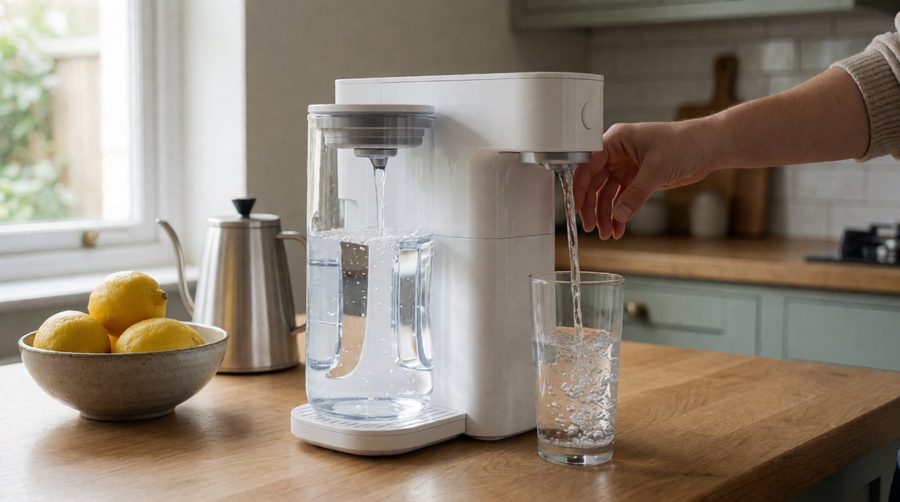
Both use the same membrane technology. The difference is where the water comes from and how much work goes into fitting them.
| Countertop RO | Under-sink RO | |
|---|---|---|
| Installation | None - unbox, fit the filter, plug in | Tees into the cold supply and drain, usually a new tap through the worktop |
| Water supply | Fill the reservoir with tap water by hand (4-5.5 litres on most) | Continuous from the mains |
| Waste water | Collected in a container you empty | Runs straight to the drain |
| Hot water | Many have instant hot (85-100°C) | Rare; needs a separate boiling tap |
| Renters | Ideal - takes nothing apart | Needs landlord permission |
| Moving house | Unplug and pack | Uninstall and refit |
| Space | Roughly 20-28cm of worktop width | Cupboard space under the sink |
If you own your home and drink a lot of water, an under-sink reverse osmosis water filter saves refilling a reservoir several times a day; our iSpring RO systems and Frizzlife systems cover both styles. For a flat, a rental or a kitchen where you can't drill, a countertop RO system is the simpler choice. They are also light enough to move between rooms, offices and holiday lets; see our portable reverse osmosis systems if you want the most compact options.
The simplest units filter into a jug or carafe and do nothing else. They are quieter, lighter and cheaper to run. The Waterdrop C1SL, the Ecoviva WP-RO-200G-W and the glass-jug Bluevua ROPOT range are in this group. They make sense if you mostly want cold water for drinking and filling bottles.
These add a thick-film heater that brings RO water up to 85-100°C in about three seconds, so a single machine replaces both the kettle and the filter jug. Waterdrop's K19-H gives four modes from 45-95°C in 5°C steps; the Ciarra SusGreenable heats with 2,300W to 100°C. Because the water has already lost most of its calcium and magnesium, you get no limescale on the element - a real bonus in UK hard water areas, where the Drinking Water Inspectorate notes that scale shortens the life of kettles and heating elements.
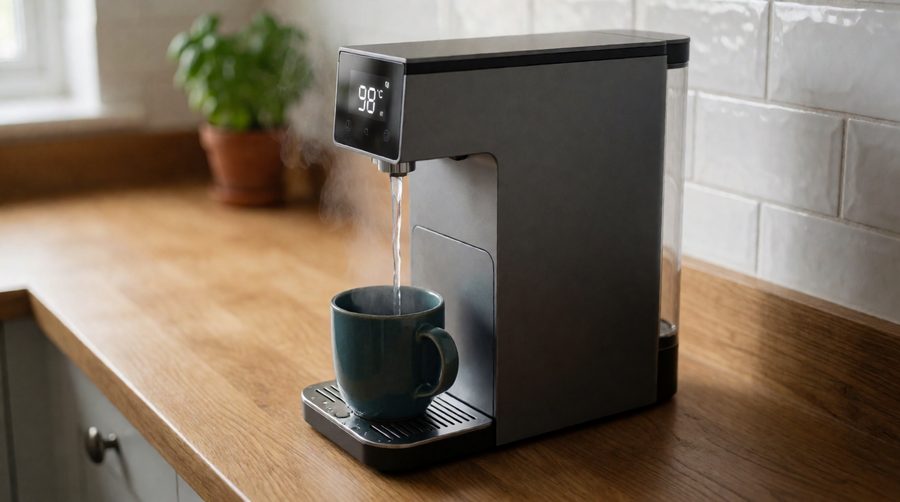
The top tier also chills, giving you cold water on tap without a fridge jug. The Waterdrop A2 and A2G dispense from 10°C to 95°C, while the Jimmy R9 Pro gives 10-15°C cold water plus six hot presets up to 98°C and pours set volumes of 120-500ml. They take more worktop and more power, but they do the job of a kettle, a water cooler and a filter in one.
Real figures from the manufacturers' listings for models in our range:
| Model | Stages | Feed / clean tank | Pure : drain | Max input TDS | Hot water | Filter life |
|---|---|---|---|---|---|---|
| Waterdrop C1SL | 7 | 5L | 3:1 | 500 ppm | No (room temp) | 12 months |
| Waterdrop C1H | 6 | 3.2L | 3:1 | - | Up to 85°C, 5 settings | 12 months |
| Waterdrop K19-H | 5 | - | - | 300 ppm | 45-95°C, UV | About 1 year |
| Waterdrop A2 | RO composite | 1.1L jug | 3:1 | 2,000 ppm | 10-95°C hot and cold | 12 months |
| AquaTru Classic Alkaline | 4 | 2.7L carafe | - | 500 ppm | No | 6 months-2 years |
| Langwater TheWell 2 | 3+1 with UV | 2.5L | 2.3:1 | 300 ppm | Up to 90°C | RO 2 years, carbon 1 year |
| Ciarra SusGreenable | 5 | 4.3L / 1.2L | 2:1 | - | Room to 100°C | Up to 2,000L |
| Jimmy R9 Pro | 7 with UV | 5.5L | - | 500 ppm | 10-15°C cold, up to 98°C | RO 24 months |
| Frizzlife WB99-H | RO + alkaline, UV | 4.5L / 3L | - | - | 45-100°C | RO 12 months |
| Vortex Air H2 Oasis | Carbon + RO | 4.5L | 3:1 (75% saving) | 2,000 ppm | 45-100°C | 12 months |
A dash means the listing doesn't give the figure, so check the product page before you buy. For the brand's full line-up, browse our Waterdrop reverse osmosis systems.
Every unit has a maximum input TDS (total dissolved solids). Feed it harder water than it is rated for and the membrane scales up and wears out early. England's water is far harder than Scotland's, and the South East is the hardest region, where hardness often sits around 250-300 mg/l. Your water company publishes a free water quality report for your postcode, which the DWI advises checking before you buy a filter. In a very hard water area, favour a model rated to 1,000-2,000 ppm such as the Waterdrop A2 or Vortex H2 Oasis over one capped at 300 ppm.
Reverse osmosis always rejects some water to flush the membrane. Older under-sink designs could send 3-4 litres to the drain for every litre made; most countertop models now run 2:1 to 4:1 pure to drain. A 3:1 unit makes 3 litres of clean water for every litre rejected, so the waste tank needs emptying far less often. On a water meter that matters, and you can use the rejected water for plants or cleaning.
RO removes the good minerals along with the bad, and plain RO water can taste flat. Look for a mineral or alkaline stage - the Waterdrop C1SL, Langwater TheWell 2 and AquaTru Classic Alkaline all add calcium and magnesium back. This also answers the main health concern about reverse osmosis water.
The NHS recommends 6 to 8 glasses of fluid a day, so a household of two can get through 5 litres of drinking water daily once tea, coffee and cooking are included. Dreo rates its twin-jug 5 litre unit for 3-4 people; carafe models of 1.7-2.7 litres suit one or two. Output speed is quoted in GPD (gallons per day): the Waken C11 is rated at 418 GPD and fills a cup in 14 seconds, the SimPure Y9A at 300 GPD and the Vonwater CT910H at 100 GPD. Higher GPD means less waiting at the jug.
NSF/ANSI 58 is the standard for reverse osmosis performance, 53 covers health contaminants such as lead, 401 covers emerging contaminants, and 372 confirms lead-free materials. "SGS tested" usually means a lab test of the product rather than an ongoing certification, so treat full NSF certification as the stronger claim.
Carbon and pre-filters typically last 6-12 months and the reverse osmosis membrane 12-24 months, depending on how hard your water is and how much you use. Before you buy, check the replacement filter is sold in the UK and note its price; brand-specific cartridges are normal on countertop units.
Some listings are US or EU versions. A heater-equipped unit needs to be rated for 220-240V, and an EU two-pin plug needs a proper adapter. Check the voltage in the product details first.
UK mains water is tightly regulated and tested, and the DWI's view is that it is safe to drink as it comes. People buy countertop reverse osmosis systems for better water quality at home: to cut chlorine taste, limescale, fluoride, PFAS or traces of lead from old pipes, or to stop buying bottled water. Two litres of bottled water a day adds up to over 700 litres a year, plus the plastic, while a countertop RO filter changes its cartridges once or twice in that time. If fluoride is your reason, the NHS explains where and why it is added. Whichever reason applies, a remineralising model and on-time filter changes give the best-tasting and safest result.
If you've already decided on a brand, our APEC and AquaTru reverse osmosis water filters ranges are worth a look too, and 8-stage RO systems add extra UV and mineral steps.
Most don't. You fill the feed tank from the tap and plug the unit into a socket. A few designs can also be connected to the cold supply for a continuous feed, but that is an option rather than a requirement.
It depends on the ratio. At 3:1, for every 3 litres of drinking water about 1 litre is rejected into the waste tank. At 2:1 that becomes 1 litre per 2. Countertop models are much more efficient than older under-sink systems.
RO water is very low in dissolved minerals. Most of your calcium and magnesium comes from food, but a remineralising stage restores some minerals and improves the taste, so it is worth choosing one.
Instant hot models heat to 85-100°C in about three seconds, which is hot enough for tea and most cooking. As the water has had its minerals removed, there is no limescale to descale.
Usually every 6-12 months for the carbon and pre-filters and 12-24 months for the membrane. Most units show filter life on the display and change with a quick twist.
Yes. The membrane rejects most fluoride, heavy metals and PFAS, which is the main difference between reverse osmosis filtration and an ordinary carbon filter jug.
