
Our product rankings are based on analysis of thousands of customer reviews, brand reputation, pricing trends, and popularity data. They represent our honest opinion and are intended as a helpful starting point for your research. Some links on this site are affiliate links — if you buy through them, we may earn a small commission at no extra cost to you. This helps us keep the site free and up to date.
 Termoidraulica RV Direct Reverse Osmosis System (70 Lt/H, Vane Pump)
 HBN Hot & Cold Countertop Reverse Osmosis Water Filter System (Model CP-UTJ-W52C)
 Cellthyhomes S01 Reverse Osmosis Water Filter (800 GPD, Tankless)
 Waterdrop T3-M Remineralisation Reverse Osmosis System (450 GPD, Tankless)
 Viva21 Reverse Osmosis System (6-Stage Alkaline)
 Langwater TheWell 2 Reverse Osmosis Water Filter (Peach, Countertop)
A 7 stage reverse osmosis system takes the classic five-filter RO setup and adds two extra filters, usually a remineralising filter and an ultraviolet lamp, so your drinking water is filtered, freshened and has some calcium and magnesium put back before it reaches the tap. It suits households who want the fullest filtration for drinking, tea and cooking, and anyone who finds plain RO water flat.
Below are under sink and worktop models, with our buying guide underneath. Happy with fewer cartridges to change? Compare 5 stage RO systems, or see countertop RO filters if you can't plumb one in.


It is a reverse osmosis water filter that treats your water in seven separate steps before it reaches a dedicated drinking water tap. The heart of it is the reverse osmosis membrane, a thin film with pores of around 0.0001 microns. Water molecules squeeze through under mains pressure, while dissolved salts, heavy metals and most other contaminants are flushed away.
The first five steps are the same on almost every kit: one sediment filter, two carbon pre-filters, the membrane and a carbon post-filter. The last two are not standardised. Most brands add UV and a remineraliser, but some use an ionising cartridge, a second mineral filter or extra carbon instead. So the number tells you how many filters there are, not which ones. Always read the stage list before you buy.
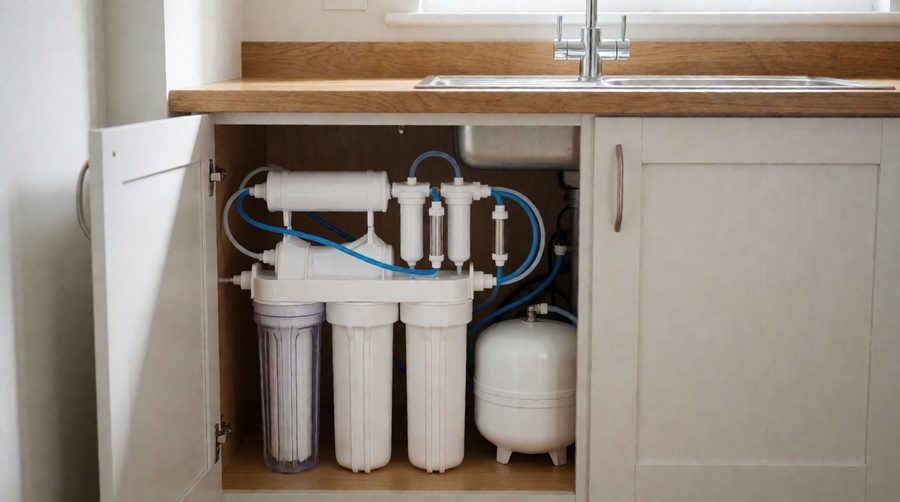
Each filter protects the one after it. This is the layout of the iSpring RCC7AK-UV, the best-known water filter system of this type in our range:
| Step | Filter | What it does | Typical change |
|---|---|---|---|
| 1 | 5 micron sediment | Traps sand, rust and scale that would clog everything after it | 6 months |
| 2 | Granular activated carbon | Takes out chlorine, odour and organic chemicals | 6 months |
| 3 | Carbon block | Removes the last traces of chlorine, which would damage the next filter | 6 months |
| 4 | RO membrane | Rejects most dissolved solids, including lead, fluoride, nitrate and hardness | 2-3 years |
| 5 | Post carbon | Polishes the taste of water leaving the storage tank | 12 months |
| 6 | Remineraliser | Adds calcium, magnesium and potassium back and lifts the pH | 6 months |
| 7 | Ultraviolet lamp | Kills bacteria and viruses just before the faucet | Bulb yearly |
Those intervals come from iSpring's own 2-year replacement pack (F21KU75): four each of the sediment, granular carbon, block and remineralising cartridges, two polishing filters, two lamp bulbs and one membrane. Heavy use or dirty feed water shortens them.

Between them, the seven filters deal with almost everything you might want out of your drinking water, which is why this is the most complete filtration you can fit at home:
Listings in our feed quote up to 97% rejection of dissolved solids for the iSpring water filter and up to 99% contaminant removal for the NU Aqua Platinum.
Not at removing contaminants. The membrane does nearly all of that, and it is the same part in a five, six or seven step filtration system. What the extra filters change is the taste, the pH and protection against bacteria after filtering:
In the UK, mains water is already disinfected and tested, so an ultraviolet lamp is a belt-and-braces extra for most homes. It earns its place on a private supply such as a well, borehole or spring, where the Drinking Water Inspectorate's point of use treatment guidance lists it for deactivating pathogens at the drinking tap. It also helps if water sits unused for days, as in a holiday let.
Reverse osmosis strips out the good with the bad, so plain RO water contains very little calcium and magnesium and tastes flat to many people. The DWI notes that the World Health Organization recommends adding minerals back when RO water is used for drinking. The Waterdrop C1SL, for example, puts potassium, calcium, sodium and magnesium back and aims for a pH of around 7.5.
Every figure below comes from the manufacturer's listing in our product feed. GPD is US gallons per day under test conditions; one gallon is 3.785 litres, so a 75 GPD water filter makes about 284 litres a day. Cold UK water flows a little slower.
| Model | Type | Output | Power | Feed water | Notes |
|---|---|---|---|---|---|
| iSpring RCC7AK-UV | Under sink, 12 litre tank | 75 GPD (~284 litres) | Mains pressure, 11W lamp | 45-70 psi, up to 750 ppm TDS | NSF/ANSI 58 certified, 1-year warranty |
| Home Master Artesian TMAFC-ERP | Under sink, with tank | Up to 1 gallon a minute at the tap | Permeate pump, no electricity | 40-95 psi, up to 500 ppm | Up to 80% less waste water, yearly filters, 5-year limited warranty |
| NU Aqua Platinum 7 Stage | Under sink, with tank | 100 GPD (~379 litres) | Booster pump, corded | Pump copes with low pressure | Ultraviolet and alkaline filters, PPM meter, 3-year warranty |
| Waterdrop C1SL | Worktop, 5 litre reservoir | Jug fill | Plug-in | Up to 500 ppm | 3:1 pure to drain, NSF/ANSI 58 & 372 certified, 12-month filter |
| Waterdrop K19 | Worktop, hot water | Hot within 1 second | Plug-in | Up to 2,000 ppm | Ultraviolet lamp, 45-95°C, filter about 1 year |
| VonWater CT910 | Worktop | 528 gallons per filter | Plug-in | Tap water, no plumbing | 3:1 pure to drain, NSF/ANSI 53 & 372, live TDS display |
A plumbed-in kit gives you a separate faucet and a steady supply, but it needs a feed valve, a drain connection and usually a hole drilled in the worktop. A countertop water filter system such as the C1SL or K19 squeezes all seven steps of filtration into one or two cartridges: you fill its reservoir from the tap and it filters on demand. It suits renters and anyone who can't drill. Our portable reverse osmosis units are smaller still.
A non-pumped unit relies on mains pressure alone. The iSpring wants 45-70 psi, roughly 3.1-4.8 bar. If yours is lower, output drops and more water goes to waste, so pick a pumped model like the NU Aqua or a permeate pump design like the Home Master Artesian.
Each water filter system has a maximum total dissolved solids (TDS) rating for the water going in: 500 ppm on the C1SL and Home Master, 750 ppm on the iSpring and 2,000 ppm on the K19. A TDS pen costs a few pounds and shows where your tap water sits. Very hard water wears the RO element faster.
Every RO unit sends some water away to flush out what it rejects. The DWI warns that on a water meter this can raise bills by up to a third. Newer designs waste much less: plug-in units with a 3:1 pure to drain ratio, tankless reverse osmosis systems at around 2:1, and permeate pumps that cut waste by up to 80%.
NSF/ANSI 58 is the standard for reverse osmosis performance, and NSF/ANSI 372 covers lead-free materials. Anything plumbed into your supply must also comply with the Water Supply (Water Fittings) Regulations 1999. The DWI's page on domestic water filters and softeners explains what to check.
Seven filters means more cartridges, so budget for them before you buy a 7 stage reverse osmosis system. A typical year looks like this:
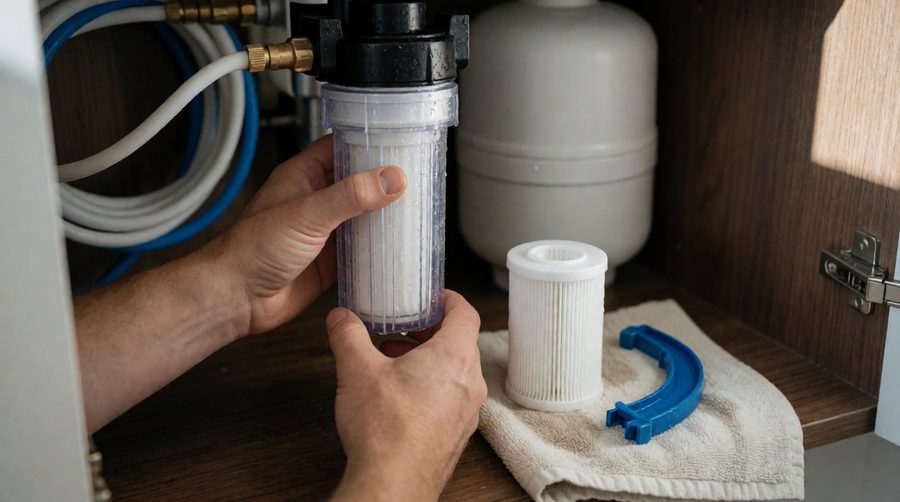
Don't stretch the schedule. The DWI warns that overdue cartridges build up deposits, breed bacteria and can leach removed material back into the water. A multi-year replacement pack such as iSpring's F21KU75 or APEC's complete set for the ROES-PHUV75 works out cheaper. If the clear first housing sits in a bright cupboard, cover it, as light encourages algae.
Most people with basic DIY skills can fit one in an afternoon. The kit connects to your cold supply and the sink waste:
The check valve stops water flowing backwards through the system. Backflow protection is a legal requirement for anything connected to the mains, set out in the WRAS installation requirement notes. If you're not sure, use a qualified plumber. Flush the first tank or two away before drinking, as new carbon releases fine dust.
Usually sediment, granular carbon, carbon block, the RO membrane, a polishing carbon filter, a remineraliser and an ultraviolet lamp. The first five are standard; the last two vary by brand of filtration system.
If you want mineralised water and extra protection from germs, yes, and it makes most sense on a private supply. On treated mains water a 6 stage unit gives a similar taste with one less cartridge to buy.
The DWI puts the waste stream at 20-30% of the incoming flow. Worktop units at 3:1 send one litre away for every three you drink.
Yes. Plug-in models such as the Waterdrop C1SL, Waterdrop K19 and VonWater CT910 have all seven filters and need only a socket.
Only for the ultraviolet lamp, a booster pump or a plug-in unit. A basic reverse osmosis water filter without a lamp runs on water pressure alone.
