
Our product rankings are based on analysis of thousands of customer reviews, brand reputation, pricing trends, and popularity data. They represent our honest opinion and are intended as a helpful starting point for your research. Some links on this site are affiliate links — if you buy through them, we may earn a small commission at no extra cost to you. This helps us keep the site free and up to date.
An iSpring reverse osmosis system fits under the kitchen sink and feeds its own drinking water tap, pushing your water through a 0.0001 micron membrane to take out up to 99% of lead, fluoride, chlorine, PFAS and dissolved solids. The American brand is best known for the RCC7AK, a 6-stage system that puts calcium and magnesium back in for a better taste.
Below you'll find the iSpring models and replacement filter packs we list, with a buying guide underneath for anyone fitting one in a UK kitchen. Comparing brands? See our Waterdrop RO systems or every tankless reverse osmosis system.




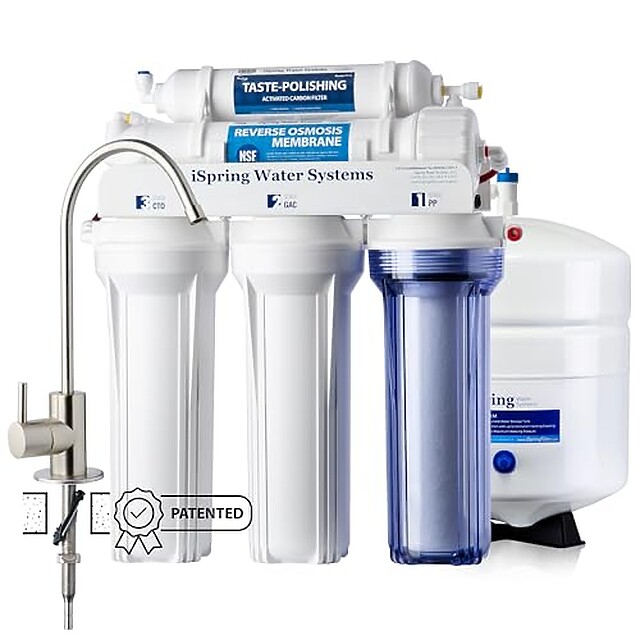
iSpring is a water filtration company based in Georgia in the USA that has sold home systems since 2007. Its under sink reverse osmosis range is among the best-selling water filter systems on Amazon, and the RCC7AK is the model most reviewers test against. The UK versions ship with 3/8" and 1/2" BSP adapters so they connect to British plumbing.
Every iSpring reverse osmosis filtration system works the same way at its core:
Count those up and you get the 5, 6 and 7-stage names you'll see across the range. Filtered water is stored under the sink in a small pressurised tank (or, on tank-free models, comes straight off the membrane) and is drawn from a dedicated drinking water faucet next to your main kitchen tap.
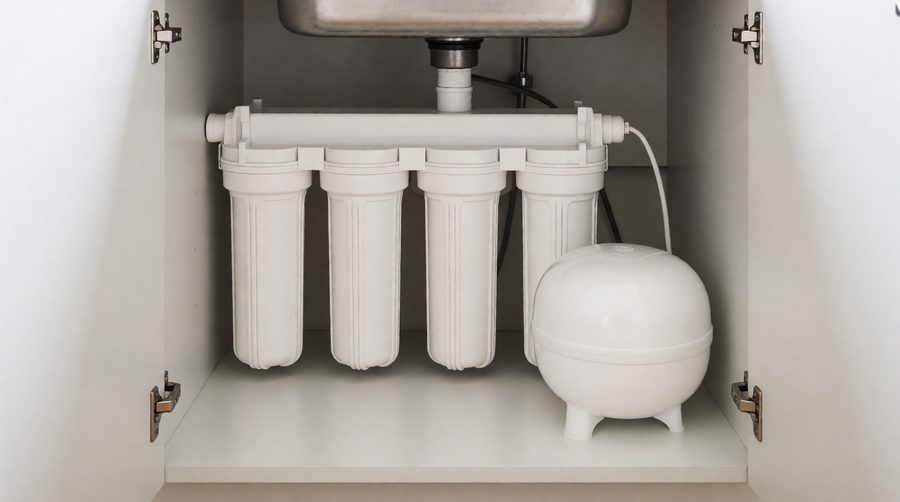
A jug water filter mainly improves taste. Reverse osmosis water filtration goes much further, and contaminant removal is the main reason people buy one.
The iSpring RCC7AK is NSF certified to NSF/ANSI 58, the standard for reverse osmosis drinking water systems, and the certification covers the full system rather than a few components. Its Amazon UK listing quotes these certified reductions:
Independent testing backs most of that up. TechGearLab's lab review of the iSpring RCC7AK found:
UK tap water is already among the safest in the world, and the Drinking Water Inspectorate's advice on home filters is worth reading before you buy. Most UK buyers choose RO for the taste, for hard-water areas where kettles fur up quickly, for old lead supply pipes, or to stop buying bottled water.
If you rent or can't drill the worktop, an under sink water filter probably isn't for you; look at a plug-in countertop unit instead, which needs no installation at all.
Here's how the iSpring reverse osmosis systems in our range line up, using the figures from each product's specifications. GPD means US gallons per day; 75 GPD is about 284 litres.
| Model | Stages | Output | Storage | Power | Best for |
|---|---|---|---|---|---|
| RCC7 | 5 | 75 GPD (284 L) | 3.2 gal | None | Plain RO on good water pressure |
| RCC7AK / RCC7AK-BLK | 6 (alkaline) | 75 GPD (284 L) | 3.2 gal | None | Most homes; the classic pick |
| RCC7P-AK | 6 (alkaline) | 75 GPD (284 L) | 3.2 gal | Booster pump | Low water pressure |
| RCC7AK-UV | 7 (alkaline + UV) | 75 GPD (284 L) | 3.2 gal | UV lamp | Private or well supplies |
| RCC2AK | 6 (alkaline) | 200 GPD (757 L) | 3.2 gal | Mains | Bigger households |
| RO400 / RO500AK | Multi-layer cartridges | 400-500 GPD | None, direct flow | Mains (RO400) | Small cupboards, fast flow |
| RCC1D / RCC1DP | 5 (RO/DI) | 150 GPD (568 L) | None | Pump (RCC1DP) | Aquariums, zero-TDS water |
Stock moves around, so a few of these may be showing as unavailable in the grid above at any given time.
The RCC7 is the plain version: sediment, GAC, carbon block, RO membrane and post-carbon, rated at 75 GPD with no power needed. It cuts TDS by 80-90% and wants 45-70 psi of incoming pressure. If you don't mind slightly flat-tasting reverse osmosis water, it's the simplest iSpring to own. It's also a typical 5-stage reverse osmosis system, so standard 10" x 2.5" cartridges fit.
The iSpring RCC7AK adds a sixth stage that puts calcium, magnesium and potassium back into the water and lifts the pH above 7. That's the main complaint about plain reverse osmosis water (it can taste flat and slightly acidic) dealt with in one cartridge. It's the model in most reviews, the one with the patented top-mounted faucet, and still non-electric. The RCC7AK-BLK is the same 6-stage reverse osmosis system with a black faucet, and both are NSF certified. See more 6-stage systems from other brands.
Standard models need at least 40 psi (about 2.8 bar) to work well, and many UK homes, flats on upper floors in particular, fall short. The RCC7P-AK adds a booster pump, so the membrane works at full pressure, the tank fills faster and less water goes to the drain. If your cold tap is weak, this is the iSpring reverse osmosis system to buy.

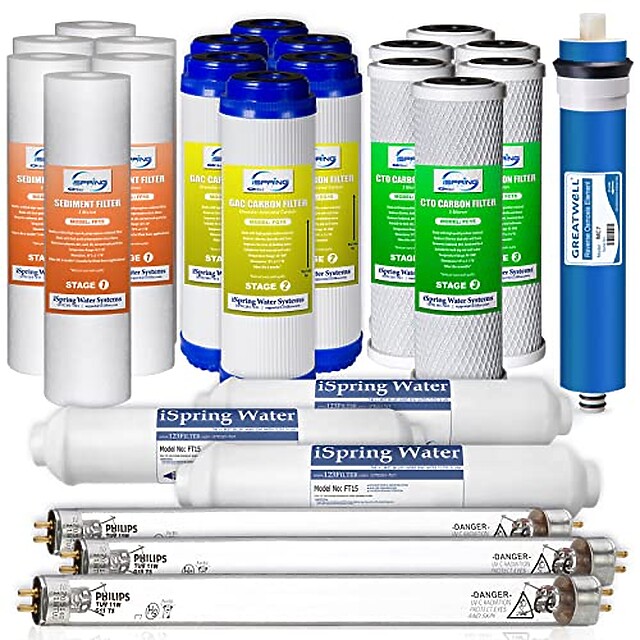
The 7-stage version adds an 11-watt UV lamp after the filters to kill bacteria and viruses. On treated UK mains water that's rarely needed, but it makes sense on a private supply or borehole. Compare other 7-stage RO systems if UV is on your list.
The RCC2AK is the newer under sink reverse osmosis model for larger households: 200 GPD, a pressure-regulating pump, the same alkaline stage and a clear first housing. Because it needs power, plan for a socket in the cupboard.
The RO400 and RO500AK skip the storage vessel altogether. Water comes straight from the filters at up to 0.4 gallons a minute, filling a glass in under 8.5 seconds on the RO500AK. iSpring says they take up to 70% less under sink space and waste far less water than the RCC7 series. A built-in light shows when to change the cartridges. They suit small kitchens and anyone who hates changing six separate filters.
These add a deionisation stage after the membrane to strip water to zero TDS. That's ideal for reef tanks, window cleaning and lab use, but not something to drink every day, because it has no minerals at all.
Before installation, this matters more than anything else. Screw a cheap pressure gauge onto an outside tap or washing machine valve. Over 3 bar (about 45 psi) and a standard iSpring RCC7AK will work well. Under that, choose the RCC7P-AK, the RCC2AK or a pumped direct-flow unit, otherwise the system will refill slowly and more water will go to waste.
A family of four drinking and cooking with reverse osmosis drinking water might use 10-20 litres a day. The 75 GPD models produce far more than that, but the 3.2-gallon tank only holds about 12 litres, and less of that is usable because part of it is air. If you fill large pans or a water dispenser often, the 200 GPD or tankless models keep up better.
If taste is the reason you're buying, get an AK model. If you want the purest possible water for coffee machines, irons or aquariums, a plain RCC7 or an RO/DI unit is better.
The RCC7 series needs roughly 40cm of width plus room for the storage vessel beside it. Direct-flow units are far slimmer. If you have no space under the sink at all, look at countertop reverse osmosis instead.
iSpring designs its systems for DIY installation, with push-fit connectors, colour-coded tubing and step-by-step videos. Most people with basic plumbing skills can manage the installation in two to three hours.
Any fitting connected to the mains in England and Wales must comply with the Water Supply (Water Fittings) Regulations 1999, including backflow protection. A WRAS approved plumber can do the job if you'd rather not.
This is where an iSpring system really costs money, so it's worth knowing the schedule before you buy:
| Filter | Change every |
|---|---|
| Sediment, GAC and carbon block pre-filters | 6-12 months |
| Alkaline (AK) filter | 6-12 months |
| Post-carbon filter | About 12 months |
| RO membrane | 2-3 years |
| UV lamp (UV models) | About 12 months |
Buying a pack is cheaper than individual replacement filters:
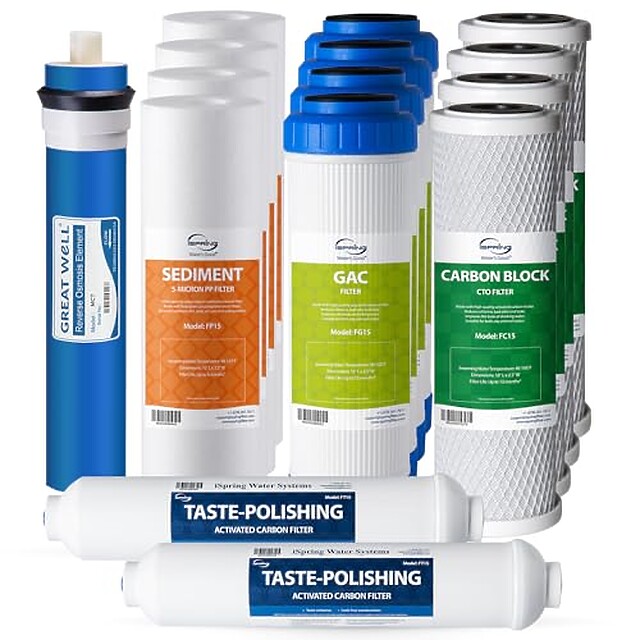
The F15-75 is a two-year supply for 5-stage systems like the RCC7, with four of each pre-filter, two post-carbon filters and an MC7 membrane, and it also fits APEC and other standard 10" x 2.5" housings. The F25U75 covers UV systems for three years with 25 filters. iSpring itself puts the RCC7AK's running cost at about $0.17 a day, around £45-50 a year, far less than bottled drinking water. Change the pre-filters on time: a clogged sediment or carbon filter lets chlorine through, which shortens the RO membrane's life and lets more contaminants into your drinking water.
All reverse osmosis sends some water to the drain. That's how a reverse osmosis system flushes away the contaminants it removes. The rated or measured figures across the range:
A pump helps a lot, because the membrane works best at higher pressure. If you're on a water meter, it's worth factoring in.
iSpring systems come with a one-year limited warranty and lifetime technical support from its US team, and the brand rates highly on Trustpilot for phone help with installation. Bought through Amazon UK, you also get Amazon's own returns window. Full manuals and videos are on iSpring's website.
iSpring's edge is that most of its RCC7 series systems take standard filters, so you aren't locked into one supplier, and the RCC7AK has more independent lab testing behind it than almost any other home RO system.
Yes. It's been making filters since 2007, its main systems are NSF/ANSI 58 certified, and the RCC7AK scores well in independent lab tests. The main complaints are about tricky filter changes, not water quality.
Yes. The RCC7AK is certified to cut fluoride by more than 97%, and lab tests found about 99%.
The RCC7, RCC7AK and RCC7AK-BLK don't. Pump, UV, RCC2AK and direct-flow models need a socket under the sink.
Standard models want 40 psi (about 2.8 bar) or more. Below that, choose the RCC7P-AK or another pumped model.
Yes. Most iSpring tank systems can feed a fridge's water dispenser or ice maker with an extra tee and tubing.
Reverse osmosis water is safe. It has fewer minerals than tap water, which is why most buyers choose an AK model that adds calcium and magnesium back in. For travel, see our portable reverse osmosis systems.

