
Our product rankings are based on analysis of thousands of customer reviews, brand reputation, pricing trends, and popularity data. They represent our honest opinion and are intended as a helpful starting point for your research. Some links on this site are affiliate links — if you buy through them, we may earn a small commission at no extra cost to you. This helps us keep the site free and up to date.
 Waterdrop T3-M Remineralisation Reverse Osmosis System (450 GPD, Tankless)
 Waterdrop T3-C Tankless Reverse Osmosis System (8-Stage, 450 GPD)
 Frizzlife PX600 RO Reverse Osmosis System (8-Stage, 600GPD)
 Langwater TheWell 2 Reverse Osmosis Water Filter (Peach, Countertop)
 Waterdrop G5P500A Alkaline Mineral pH+ Reverse Osmosis Water Filter (8-Stage, Tankless)
 Waterdrop G3P600 Reverse Osmosis (600 GPD, Under Sink)
8 stage reverse osmosis systems are mostly compact tankless units that fit under the kitchen sink and send water through layered sediment, carbon and membrane filters before it reaches a separate drinking water faucet. Each reverse osmosis system works on demand with no storage tank. They produce 400-600 gallons a day, so they suit busy households, keen tea and coffee drinkers and anyone short of cupboard space for a storage tank.
Every model below is listed with real specs in the buying guide underneath. Want the same idea with a different filter count? Compare 7 stage RO systems or our wider range of tankless reverse osmosis filters.


It is a reverse osmosis water filter system that treats your tap water in eight filtration steps before it reaches a dedicated drinking water faucet. The step that does the real work is the RO membrane, a thin film with pores of about 0.0001 microns. Mains pressure (helped by a small pump on most tankless units) pushes water molecules through it, while dissolved solids, heavy metals and most other contaminants are rinsed away down the drain.
What surprises most buyers is that "eight" rarely means eight separate housings. Almost every RO system in this range uses just three twist-in filters, each packed with several layers of media, and the brand counts the layers. Reinmoson's spec sheet spells it out: three layers in the RO cartridge, three in the pre-filter and two in the post filter. So the number tells you how the filtration system is built, not that you have eight replacement filters to buy.
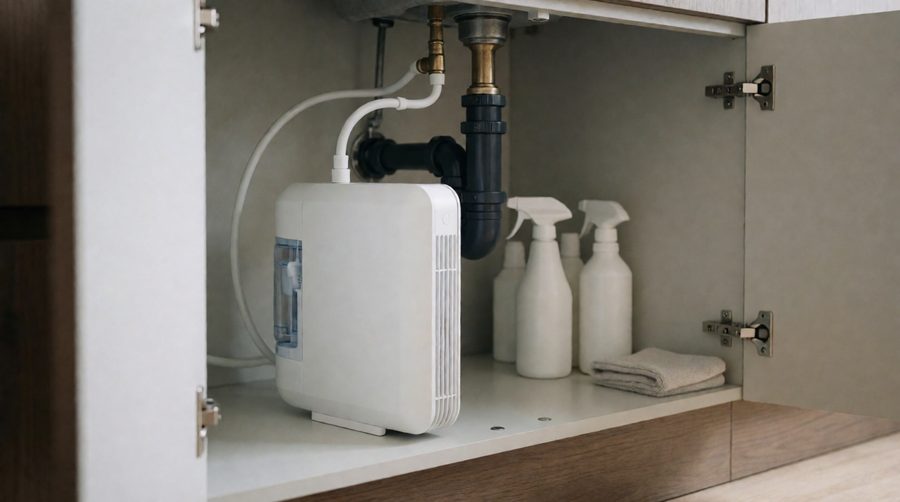
Layouts vary slightly by brand, but a typical tankless reverse osmosis system such as the Waterdrop G3P600 or Waterdrop T3-C is arranged like this:
| Cartridge | Layers inside | What it removes | Typical change |
|---|---|---|---|
| Pre-filter (CF / PPC) | PP cotton sediment, carbon block, activated carbon | Sand, rust and silt, then chlorine, taste and odour that would damage the membrane | 6-12 months |
| RO cartridge | PP cotton, RO membrane, carbon | Dissolved solids, lead and other heavy metals, fluoride, nitrate, PFAS and limescale minerals | 24 months |
| Post filter (CB) | Activated carbon, sometimes a mineral or alkaline layer | Polishes the taste; alkaline versions add minerals back | 12 months |
Those intervals come from the listings in our feed: the Waterdrop T3-C quotes 6 months for the CF filter, 12 for the CB filter and 24 for the RO cartridge, and Frizzlife gives 6 months, 1 year and 2 years for the PX500-A. Hard water and heavy use shorten them, as both make the filtration media work harder.
Not at removing contaminants. The RO membrane does nearly all of that, and it is the same kind of part in every reverse osmosis system. What really separates this group from the rest is the design: almost all of them are tankless reverse osmosis units with high output, while older five and six step kits use a storage tank and a 50-75 GPD membrane.
One mix-up worth knowing: "8 inch" reverse osmosis is something else entirely. Those are industrial membranes eight inches across, built for factories and laboratories, not kitchens.
Every figure below comes from the manufacturer's listing in our product feed. GPD means US gallons per day under test conditions; one gallon is 3.785 litres, so 600 GPD is about 2,271 litres a day. Cold UK water slows any membrane, so expect less in winter.
| Model | Output (GPD) | Pure to drain | Max feed TDS | Certified | Worth knowing |
|---|---|---|---|---|---|
| Waterdrop G3P600 | 600 (~2,271 litres) | 2:1 | 300 ppm | NSF/ANSI 58, 42, 372; UKCA | Smart TDS faucet, 3-second filter change |
| Frizzlife PX600 | 600, flow rate 1.59 litres a minute | 2:1 | 500 ppm | 99.99% removal claimed | 20-80 psi, fits 3/8" and 1/2" UK fittings |
| Ecoviva WP-RO-600G-W | 600 (~2,271 litres) | 2.5:1 | 500 ppm | NSF/ANSI 372, 42, 58 | 97.25% TDS reduction; listed as 110-120V |
| Frizzlife PX500-A | 500 (1,893 litres) | 2:1 | 1,200 ppm | - | Alkaline post filter, 43.5-100 psi |
| Waterdrop G5P500A | 500 (~1,893 litres) | 2:1 | Not stated | NSF/ANSI 372 | Adds Ca, Mg, Na and K; TDS meter included |
| Waterdrop T3-C | 450 (~1,703 litres) | 2:1 | Not stated | NSF/ANSI 372 | All-in-one filters, under sink or wall-mounted |
| Stokk S1 | 400 (~1,514 litres) | 2:1 | 300 ppm | NSF/ANSI 42 & 58 (SGS tested) | Smallest housing, auto flush, 5-38°C |
The Ecoviva listing gives its power as AC110-120V/60Hz, the US supply. UK mains is 230V, so check with the seller that a UK adaptor or power supply is included before you order.
A tankless water filter of this size is overkill for a single glass a day, but it earns its place when:
If you rent or can't drill the worktop, skip to the plug-in options further down.
Each reverse osmosis water filter has a maximum TDS (total dissolved solids) for the water going in: 300 ppm on the G3P600 and Stokk S1, 500 ppm on the PX600 and Ecoviva, and 1,200 ppm on the PX500-A. A TDS pen costs a few pounds and shows where your tap water sits. In a hard-water area, pick a unit with headroom, as running near the limit wears the membrane faster.
Tankless units save room, but they are not tiny. The Stokk S1 is 37 x 11.4 x 30.4cm, the G3P600 45 x 14.4 x 46cm and the PX600 58 x 22.5 x 51cm. Leave space at the front to twist the filters out, and note that most need a socket in the cupboard for the pump and display.
The built-in pump means a tankless RO system copes with a wider range of pressure than old tank kits: 20-80 psi (about 1.4-5.5 bar) for the PX600 and 43.5-100 psi (3-6.9 bar) for the PX500-A. For one or two people, 400-450 GPD is ample; the 600 models pay off when the faucet is busy filling pans, bottles and kettles. Low pressure slows the flow rate and sends more water to drain, so check yours with a cheap gauge on an outside tap.
After filtration, plain reverse osmosis water has very little calcium and magnesium left, and some people find it flat. The Drinking Water Inspectorate notes the World Health Organization recommends adding minerals back when RO water is used for drinking. Alkaline models such as the G5P500A and PX500-A do that in the last filter, so the reverse osmosis water tastes closer to a good bottled water.
Every reverse osmosis water filter sends some water away to flush out what the membrane rejects. Older kits could waste three or four litres for every one you drink; the units here manage 2:1 or 2.5:1, so one cup goes to drain for every two or two and a half you keep. The DWI's guide to domestic water filters and softeners still warns that the waste stream can raise a metered bill by up to a third, so the better ratio matters.
Budget for each replacement filter as well as the unit itself:
Don't stretch the schedule. The DWI warns that cartridges left too long stop working and can leach chemicals or bacteria back into the water. The smart display on these units counts down filter life for you, which takes the guesswork out of it.
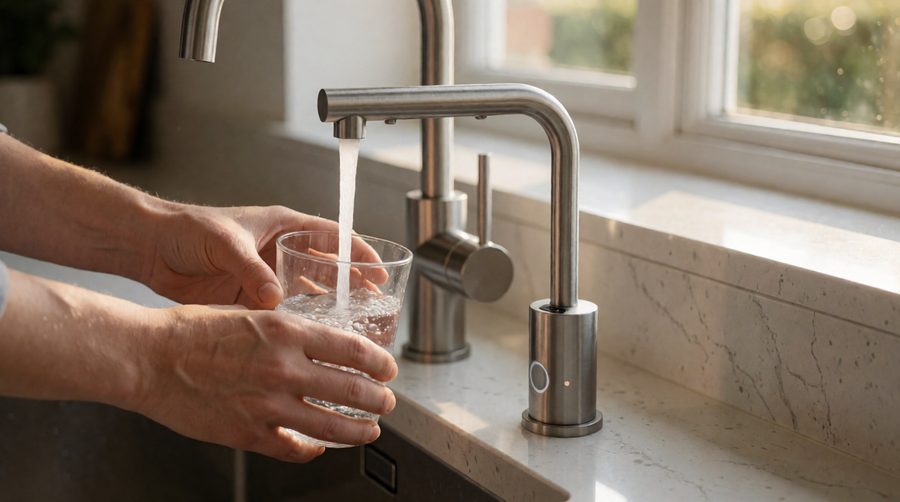
Most people with basic DIY skills can fit one in an hour or two; Frizzlife quotes 30 minutes for the installation of the PX600. You will need:
Two legal points apply to any UK installation. Anything connected to the mains must have backflow protection under the Water Supply (Water Fittings) Regulations 1999, explained in the WRAS installation requirement notes. And the DWI says that by law you must tell your water company before you install a reverse osmosis filtration system. If you'd rather not drill, a plug-in unit from our countertop RO range needs no plumbing at all, and portable reverse osmosis units are smaller still.
After fitting, let the automatic flush finish and run the faucet for the time the manual gives before drinking, as new carbon releases fine dust.
Usually PP cotton sediment, carbon block and activated carbon in the pre-filter, a sediment layer, the membrane and carbon in the RO cartridge, and a final carbon or mineral layer in the post filter. Brands count the layers differently, so read the listing.
Six hundred US gallons of filtered water a day, about 2,271 litres, under test conditions. In practice it means a glass fills in a few seconds rather than a slow trickle.
Almost all tankless models do, for the booster pump, the auto flush and the faucet display. Check you have a socket under the sink.
No. Hot water damages the membrane. Every RO system here is built for cold water only; the PX500-A, PX600 and Stokk S1 list 4-5°C to 38°C.
Yes. The membrane rejects fluoride, chlorine, lead and the calcium that causes scale, which is why kettles stay clean. The G3P600 listing names fluoride, arsenic, radium and PFAS among the contaminants it reduces.
Yes. These are twist-in cartridges that change in seconds with no tools or plumber, and the faucet or display tells you when each one is due.
