
Our product rankings are based on analysis of thousands of customer reviews, brand reputation, pricing trends, and popularity data. They represent our honest opinion and are intended as a helpful starting point for your research. Some links on this site are affiliate links — if you buy through them, we may earn a small commission at no extra cost to you. This helps us keep the site free and up to date.
 Viva21 5-Stage Reverse Osmosis System (V21RS5S01)
 iSpring RCC1D Tankless RO/DI System (5 Stage, 150 GPD)
 GrowMax Water Power Grow 500 (5-Stage Reverse Osmosis System)
 iSpring RCC1DP Tankless RO/DI System
 NU Aqua Platinum Series 100GPD (5-Stage Under Sink)
 Ecoviva G200 Countertop Reverse Osmosis Water Filter (Black)
A 5 stage reverse osmosis system runs your mains water through a sediment filter, two carbon filters, a reverse osmosis membrane and a final carbon polish before it reaches a separate drinking water tap. It is the classic under sink water filtration system: proven, easy to service and the cheapest way to get purified drinking water for tea, coffee and cooking without buying bottles.
Below are the 5 stage reverse osmosis units in our range, from no-power kits to pumped and tankless models, with our buying guide underneath. Want an alkaline or mineral filter added back? See our 6 stage RO systems. Short on cupboard space? Compare tankless RO units.


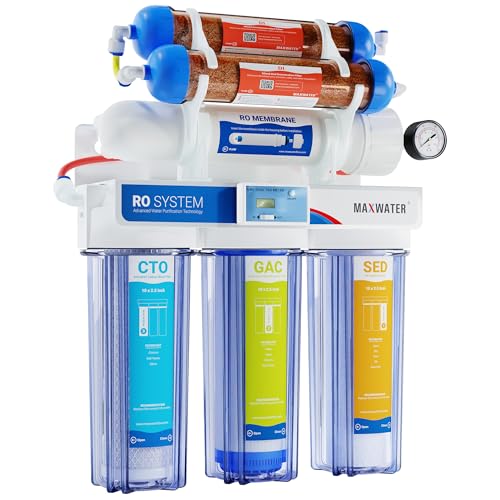


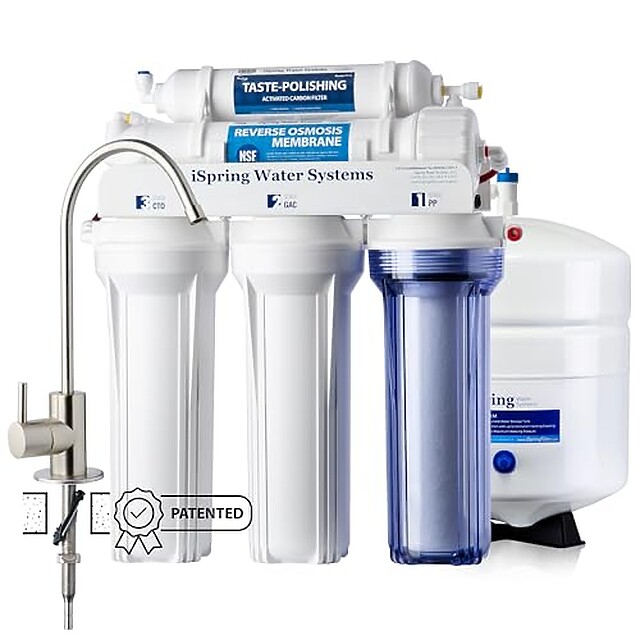

Reverse osmosis pushes water under pressure through a semi-permeable membrane with pores of around 0.0001 microns. Water molecules pass through; dissolved salts, metals and most other contaminants are flushed away. The membrane is delicate, though, and chlorine in tap water damages its thin film composite layer, so it needs filters in front of it. This design adds three pre-filters and one post-filter around it, which is why it became the standard layout for a home reverse osmosis water filter.
Most of these systems sit under the kitchen sink: a row of three filter housings, a horizontal reverse osmosis membrane housing, a small pressurised storage tank and a chrome tap on the worktop. It makes water slowly and fills the tank in the background, so you get a full glass the moment you open the tap.
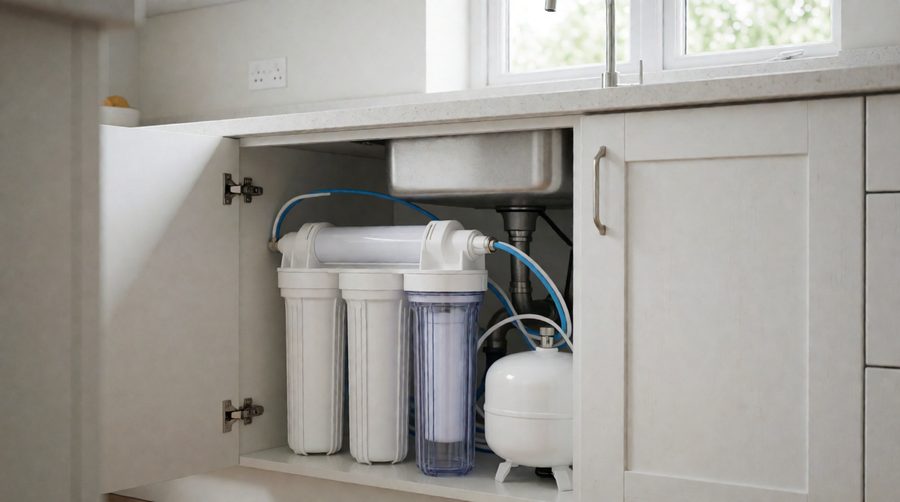
The order matters: each filter protects the one after it. This is the layout the iSpring RCC7, Geekpure and Finerfilters systems all use.
| Stage | Filter | What it does | Typical change |
|---|---|---|---|
| 1 | 5 micron polypropylene sediment | Traps sand, rust and dirt that would clog everything after it | 6 months to a year |
| 2 | Granular activated carbon (GAC) | Takes out chlorine, odour, pesticides and organic chemicals | 6 months to a year |
| 3 | Carbon block | Removes the remaining chlorine and finer particles, protecting the next filter | 6 months to a year |
| 4 | RO membrane (thin film composite) | Rejects up to around 99% of dissolved salts, lead, fluoride, nitrates and hardness minerals | 2-3 years |
| 5 | Inline post carbon | Polishes the taste of water coming out of the storage tank | 6 months to a year |
Change intervals depend on how much you draw and how dirty your feed water is. Listings in our range quote 12 months for the pre-filters on the Viva21 and Klarstein units and 24 months for the Klarstein membrane. A cheap TDS pen tells you when it is tiring: if the reading at the reverse osmosis tap creeps up, it's time.
Every figure below comes from the manufacturer's listing in our product feed. GPD is US gallons per day, measured at 60 psi and 25°C; UK mains water is colder, so expect less.
| Model | Output (GPD) | Type | Pressure / power | Notes |
|---|---|---|---|---|
| iSpring RCC7 | 75 (~284 litres a day) | Under sink, tank | 3.1-4.8 bar, no power | NSF/ANSI 58, brass tap |
| Viva21 V21RS5S01 | Not stated | Under sink, tank | Mains | NSF/ANSI 58 & 372, leak detector, feed water up to 1000 ppm dissolved solids |
| NU Aqua Platinum 100GPD | 100 (~379 litres) | Under sink, steel tank | Corded electric | 5-year warranty, PPM meter included, 4.4 stars from 446 ratings |
| iSpring RCC1D | 150 (~568 litres) | Tankless RO/DI | 2.8-5.5 bar | Near-zero TDS for aquariums, 1.5:1 waste ratio |
| Aquatic Life 540474 | 200 (~757 litres) | Wall mount | Mains-fed, garden hose adapter | Twin membranes, 97-98% rejection |
| Klarstein PureLine | 800 (~3,028 litres) | Tankless | Internal pump | 2.08 litres a minute, 2:1 pure to waste |
| Ecoviva G200 | Jug-fill | Countertop | Plug-in | 3:1 pure to waste, listed at 110-120V |
| Ciarra SusGreenable | 1.2 litre tank | Countertop, hot water | Plug-in, 2300W heater | Room, 45, 85 and 100°C, no plumbing |

A non-pumped unit like the RCC7 relies on mains pressure to push water through the membrane. Most need at least 40 psi (about 2.8 bar) and work best nearer 60 psi. Below that, output drops sharply and more water is wasted. If your pressure is under about 3 bar, buy a pumped system or add a booster pump.
One US gallon is 3.785 litres, so a 75 GPD rating means around 284 litres a day under test conditions. A household drinking and cooking with filtered water rarely uses more than 10-20 litres a day, so a 50-75 GPD system is plenty for a normal kitchen. Higher outputs matter for big families, offices, aquariums and hydroponics.
A traditional reverse osmosis kit stores 6-12 litres in a pressurised tank pushed out by a small air charge. It needs no power and keeps working through a power cut. A tankless reverse osmosis water filtration system like the Klarstein PureLine uses a pump and a high-output membrane to filter on demand from a slimmer box. If you rent or can't drill the worktop, a countertop RO filter needs no plumbing at all, and a portable unit suits caravans and boats.

Every reverse osmosis unit sends some water down the waste pipe to flush the membrane. Older non-pumped systems can waste 2-3 litres for every litre of pure water; the Geekpure listing quotes 2 gallons of waste per gallon. Pumped and tankless systems do better, with ratios of 2:1 or 3:1 in favour of pure water. If you're on a water meter, that difference adds up.
NSF/ANSI 58 is the main standard for reverse osmosis drinking water units, and 372 covers lead-free materials. Many listings are US models: check the plug and voltage (the Ecoviva G200 is listed at 110-120V), and that fittings suit UK 15mm copper pipe. Fittings sold for UK plumbing can be checked in the WRAS approvals directory, and the drain connection should be fitted so waste water can never flow back into the unit.
More stages don't mean purer water. The membrane does the real work, and that's the same in every kit. Extra stages usually add something back or treat something else:
If you only want clean, great-tasting drinking water and no limescale in the kettle, a 5 stage water filtration system is enough. Pick more if you dislike the flat taste of demineralised water or are on a private supply where UV makes sense.
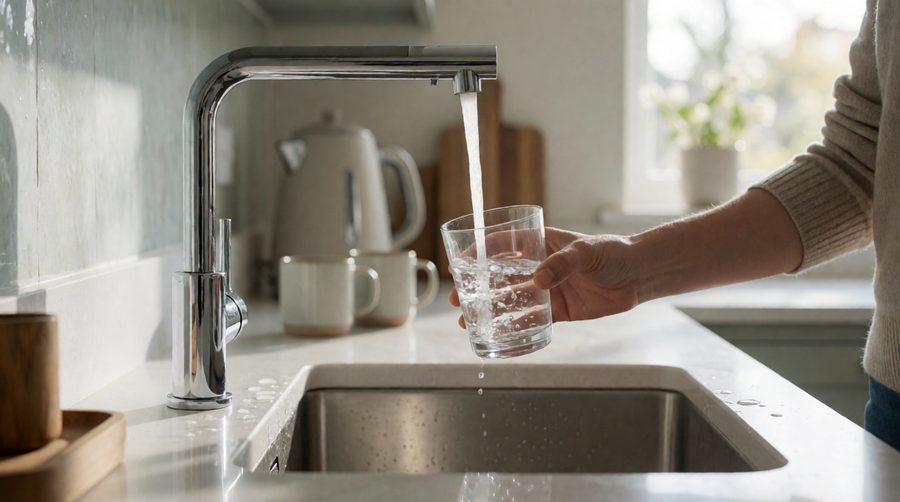
Most reverse osmosis kits are DIY jobs taking an hour or two if you're comfortable with basic plumbing: a feed valve on the cold pipe, a drain saddle on the waste pipe, a hole in the sink or worktop for the tap, then colour-coded push-fit tubing. A plumber will fit the system quickly if not. A 3 way tap replaces your kitchen mixer and saves drilling a second hole.
Prefer one brand for easy filter packs? Our iSpring RO range and APEC systems both use standard 10 inch housings.
Yes. The membrane in stage four removes the large majority of dissolved contaminants, and the carbon filters handle chlorine, taste and odour. UK tap water already meets strict standards set by the Drinking Water Inspectorate; a reverse osmosis filter is about hardness and peace of mind.
Yes. The reverse osmosis membrane reduces fluoride, nitrates and the calcium and magnesium that cause limescale, so kettles and coffee machines stay clean.
It's safe to drink; most of the minerals you need come from food. Some people find it tastes flat, which is why alkaline filters are a popular upgrade.
Only with care. Any water filtration system on a well or spring needs thought: the DWI's guidance on point of use treatment prefers whole-supply treatment, and private water may need UV for bacteria.
Pre-filters and post carbon every 6-12 months, the membrane every two to three years. Replacement packs with all four cartridges are cheap compared with bottled water.
