
Our product rankings are based on analysis of thousands of customer reviews, brand reputation, pricing trends, and popularity data. They represent our honest opinion and are intended as a helpful starting point for your research. Some links on this site are affiliate links — if you buy through them, we may earn a small commission at no extra cost to you. This helps us keep the site free and up to date.
 Langwater TheWell 2 Water Purifier (White, Countertop)
 HBN Hot & Cold Countertop Reverse Osmosis Water Filter System (Model CP-UTJ-W52C)
 Cellthyhomes S01 Reverse Osmosis Water Filter (800 GPD, Tankless)
 Viva21 Reverse Osmosis System (6-Stage Alkaline)
 Vortex Air H2 Oasis (Black, Countertop RO System)
 Langwater TheWell 2 Reverse Osmosis Water Filter (Peach, Countertop)
Portable reverse osmosis systems give you RO-filtered drinking water without plumbing anything in. You fill a tank from the tap, plug the unit in (or charge it) and it pushes the water through a 0.0001 micron membrane, so you can take it from a rented flat to a new home, an office or a caravan.
They suit renters, people who move often and anyone who wants purer water for tea, coffee and baby bottles without drilling a worktop. Most below are plug-in countertop RO units; if you own your home and want a permanent fit, see our tankless under-sink systems.


A portable reverse osmosis system is an RO water purifier that works on its own, without being connected to your pipes. Instead of a membrane housing bolted under the sink with a drain saddle and a separate tap, everything sits in one box: a fill reservoir, a small pump, the filtration cartridges and a jug or dispenser. You pour tap water in at the top or back and collect pure water at the front.
The membrane is the same filtration technology used in fixed systems. Water is forced through a membrane with pores far smaller than a bacterium, which holds back dissolved salts, limescale minerals, fluoride, heavy metals such as lead, and most chemicals, while carbon and sediment stages before it take out chlorine, taste and particles. Many models also run the water past a UV lamp or a remineralising cartridge at the end.
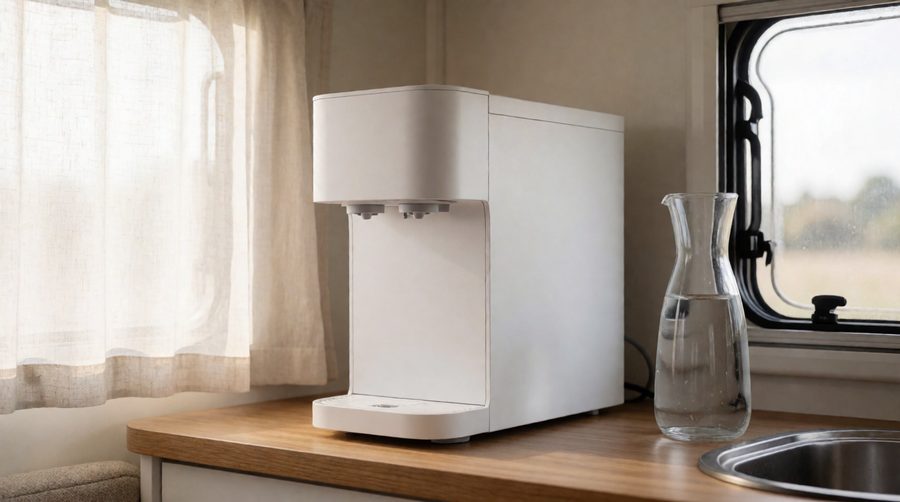
Search for portable reverse osmosis and you get three quite different products mixed together. Knowing which one you need saves a lot of returns.
This is what most of the range on this page is. They plug into a normal 230V socket, weigh roughly 4.5-9.5kg and need about the footprint of a coffee machine. They are "portable" in the sense that you can unplug one, carry it to another room or take it when you move house. Most add instant hot water, a water quality readout and a filter life reminder. Our countertop reverse osmosis page goes deeper on hot and cold dispensers, and how countertop reverse osmosis compares with a jug filter.
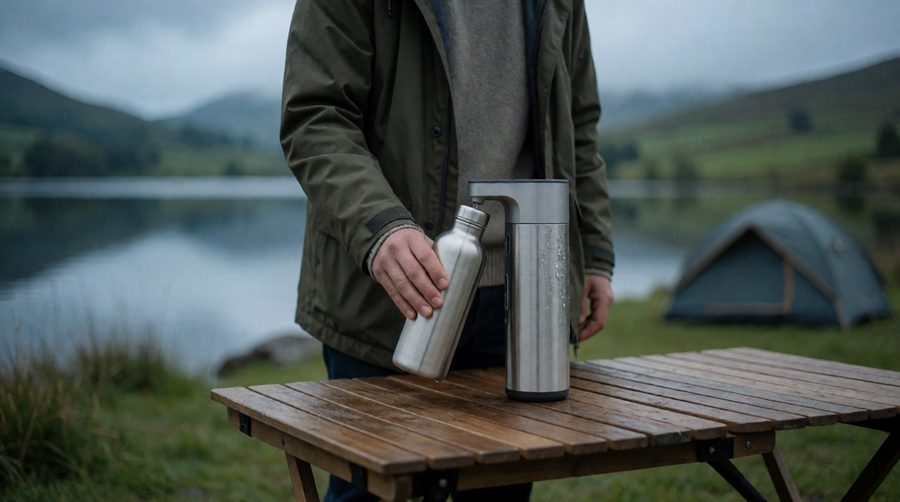
A small number of units run from a built-in battery or 12V supply so you can use them with no mains power at all. They are heavier than a camping filter but give you RO-level purification from a water carrier or a campsite tap. Read the input limits carefully: they are designed for fresh water, not salty or very dirty water.
Brands such as Geekpure and Frizzlife sell compact RO units that clip onto an outdoor tap or washing machine valve and run on mains water pressure, mainly to make soft, clean water for aquariums. Window cleaners use larger mobile RO and DI rigs for spot-free rinsing. Both are easy to move, but neither is built to give you drinking water from a jug on the side.
Figures below come from the manufacturers' specs for products in our range. Weight matters if you plan to move the unit, the efficiency ratio matters if your water supply is limited, and the maximum input TDS tells you how hard or salty your source water can be.
| Model | Power | Weight | Size (cm) | Capacity / flow | Pure : drain | Max input TDS |
|---|---|---|---|---|---|---|
| ITEHIL ITS100G-HW | 12,000mAh battery | 6.0kg | 30 x 18 x 23.4 | About 27 litres per charge | - | 300ppm |
| Slevoo C1-M20 | Mains | 4.5kg | 38.6 x 18.5 x 40.9 | 5 litres, 3.75 litres per fill | 3:1 | 500ppm |
| Dreo DR-KWF003 | Mains | 4.89kg | 39.9 x 17 x 34 | 5 litres, two 2.2 litre pitchers | 3:1 | - |
| SimPure Y7T-A | Mains | 5.7kg | 45.7 x 20.3 x 43.2 | 100 GPD membrane | 4:1 | 500ppm |
| Leysern 5-Stage UV | Mains | - | 36.8 x 28.4 x 47.2 | 4 litres | 4:1 | - |
| Langwater TheWell 2 | Mains | 9kg | 35 x 21 x 47 | Tankless, 0.4 litres a minute, hot to 90°C | 2.3:1 | 300ppm |
| Ecoviva Mate 3 | Mains | 9.4kg | 23 x 23 x 37.3 | Two pitchers + 1.2 litre kettle | 3:1 | - |
The lightest units are the Slevoo and Dreo at under 5kg, which is about what a full 5 litre bottle of water weighs. The Ecoviva Mate 3 has the smallest footprint at 23 x 23cm but is the heaviest. If you want a plug-in hot water dispenser too, our 7 stage reverse osmosis systems include several of those.
For a rented flat or office, a plug-in unit is the obvious pick: no landlord permission, no drilling, and it leaves with you. For a caravan or motorhome, check the weight, whether it will sit securely while you travel and whether your hook-up can power any hot water function. For camping or a power cut, only a battery model will do.

Plug-in units range from about 4.5kg to 9.5kg empty, plus the water inside. Measure the depth of your worktop and the space under wall cupboards: some models are 45cm or taller, and you need room above to lift the lid and fill the tank.
Every RO membrane sends part of the water to drain to flush away what it has removed. Plug-in reverse osmosis units collect it in a waste container you empty by hand. A 4:1 ratio means about 1 litre of waste for every 4 litres of pure water; at 2.3:1 you pour away noticeably more. That makes little difference at home, but in a caravan where you are carrying water from the site tap, a more efficient unit means fewer trips. The Caravan and Motorhome Club's freshwater tips are worth reading on keeping your water carrier clean as well.

More stages is not automatically better, but it does tell you what has been added around the membrane: sediment and carbon pre-filters, a post-carbon for taste, UV for bacteria, and an alkaline mineral cartridge that puts some calcium and magnesium back so the water tastes less flat. Our pages on 5 stage RO systems and 6 stage RO systems explain each stage. A typical portable RO filtration sequence looks like this:
Look for NSF/ANSI 58 testing, the standard for reverse osmosis drinking water systems, and check whether a model makes specific claims for PFAS or fluoride rather than just "99.99% of contaminants".
Each unit lists a maximum input TDS (total dissolved solids). The models here accept 300-500ppm, which covers UK mains water, including hard water areas. Flow is modest - the Langwater makes 1 litre in about 2.5 minutes and the ITEHIL 250ml a minute - so fill a jug in advance rather than expecting tap speed. Seawater is around 35,000ppm, so none of these will desalinate sea water, whatever an advert implies.

Filters are the real cost. Lifespans in our range run from 6 months (SimPure) to 1-2 years, and Langwater puts its running cost at about 12p a litre including its mineral packs. Check the replacement cartridge is easy to buy in the UK before you choose. Brands with a big UK presence, such as Waterdrop, AquaTru and Frizzlife, are the safest bet: see our Waterdrop RO systems, AquaTru countertop purifiers and Frizzlife RO filters.
Some units sold on Amazon are US models rated for 110-120V. UK sockets are 230V, so check the voltage on the listing or the plug before you buy, especially on anything with a heater.
A battery RO purifier is a big step up from a filter bottle for treating tap water you are unsure about, but it is not a survival tool for any water source. Many cheap "portable RO" camping pumps quote a 0.01 micron filter, which is ultrafiltration, not reverse osmosis: it stops bacteria but not dissolved chemicals. A true RO membrane works at a far finer level, around a hundred times smaller.
Abroad, follow the NHS advice on safe food and water when travelling: boiling is the most reliable way to make water safe, and it notes that domestic water filters designed for UK use are not suitable on their own. Use a reverse osmosis unit on top of that, not instead of it, where you are unsure of the water.
Mains water in England and Wales is regulated by the Drinking Water Inspectorate and is safe to drink. People buy a reverse osmosis unit mainly for taste, to cut limescale in kettles and coffee machines, or to reduce things like chlorine, fluoride, lead from old pipes and PFAS. The case is stronger if you are on a private supply: the DWI says about 1% of people in England and 3% in Wales use one, from boreholes, springs and watercourses, mostly in rural areas. Get a private supply tested first, as RO is not designed to deal with heavily contaminated raw water.
If you own your home and drink a lot of filtered water, a fixed under-sink unit such as an iSpring reverse osmosis system is cheaper per litre over time. A plug-in reverse osmosis system makes most sense where you cannot or do not want to plumb one in.
No. Plug-in and battery units are filled by hand from a tap or jug and store waste water in a container you empty. Only hose-connected aquarium units attach to a tap, and that is a simple screw fitting.
Yes, almost always. The membrane needs pressure, and these units create it with a small pump powered from the mains or a battery. The ITEHIL in our range runs for about 27 litres per charge.
Not the units here. They accept source water up to 300-500ppm of dissolved solids, while seawater is around 35,000ppm. Desalination needs a dedicated, much higher-pressure watermaker.
It depends on the ratio. At 4:1 you lose about 1 litre for every 4 litres filtered, at 3:1 1 litre for every 3, and at 2.3:1 a little more. Waste water can be used for plants or cleaning.
RO strips most minerals along with the contaminants, which is why many models add a remineralising stage. For most people food supplies far more calcium and magnesium than drinking water does, so this is mainly about taste.
Yes, a plug-in unit works on a mains hook-up. Empty both reservoirs before travelling and secure the unit so it cannot slide. Fill it from fresh water, as you would your kettle.
Usually every 6-24 months depending on the model and how hard your water is. Most units show filter life on the display and the cartridges twist out without tools.
