
Our product rankings are based on analysis of thousands of customer reviews, brand reputation, pricing trends, and popularity data. They represent our honest opinion and are intended as a helpful starting point for your research. Some links on this site are affiliate links — if you buy through them, we may earn a small commission at no extra cost to you. This helps us keep the site free and up to date.
 Waterdrop T3-C Tankless Reverse Osmosis System (8-Stage, 450 GPD)
 Cellthyhomes S01 Reverse Osmosis Water Filter (800 GPD, Tankless)
 Waterdrop T3-M Remineralisation Reverse Osmosis System (450 GPD, Tankless)
 iSpring RCC1D Tankless RO/DI System (5 Stage, 150 GPD)
 Ecoviva Water E8 800GPD (Tankless Reverse Osmosis System)
 Waterdrop G5P500A Alkaline Mineral pH+ Reverse Osmosis Water Filter (8-Stage, Tankless)
Reverse osmosis pushes water through a membrane with pores of around 0.0001 microns. Water molecules get through; dissolved salts, metals, chlorine by-products, bacteria and most other contaminants are flushed to the drain. A sediment pre-filter and carbon filter protect the membrane, and a carbon post-filter polishes the taste.
A traditional reverse osmosis system is slow, so it fills a pressurised storage tank (usually 8-12 litres) in the background and you draw from that. A tankless RO system swaps the tank for a pump and a high-output membrane rated at 400 GPD (gallons per day) or more. When you open the tap, the pump starts and the unit filters straight to the glass. The result is a compact box roughly the size of a large shoebox instead of a filter rack plus a storage tank, and purified water on demand that never goes stale.
This tankless design suits:
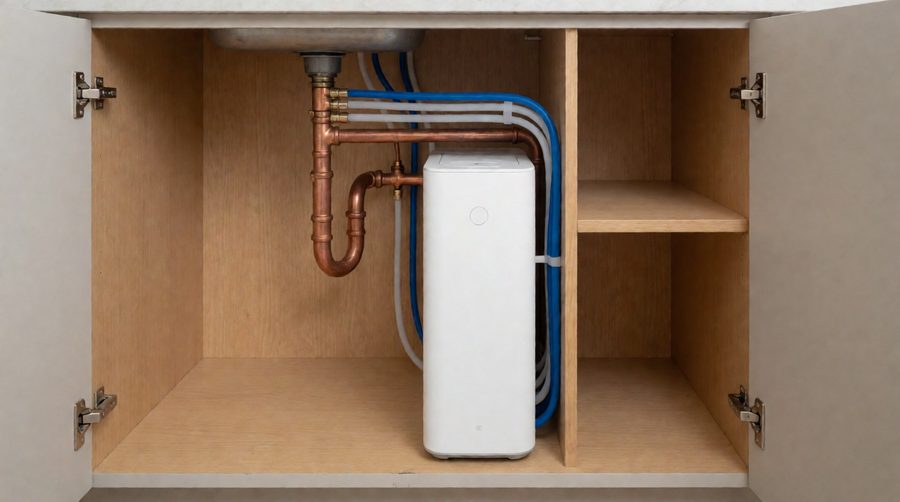
| Tankless RO | Traditional RO system with tank | |
|---|---|---|
| Cupboard space | One slim, compact unit, often 11-15cm wide | Filter rack plus a tank |
| Water freshness | Filtered on demand | Can sit in the tank for days |
| Flow rate at the tap | Steady, set by the membrane rating | Fast until the tank runs low |
| Wastewater | Usually 2:1 to 3:1 pure to drain | Often 1:1 or worse without a pump |
| Electricity | Needs a socket for the pump | Many need none |
| Power cut | No RO water until it's back | Tank still dispenses |
| Upfront cost | Higher | Lower |
| Warranty | Typically 1-2 years | Typically 1 year |
| Filters | Twist-in cartridges, no tools | Housings and tools |
For most kitchens a tankless RO system wins on space, freshness and water use. A storage tank still makes sense if you have no socket under the sink, want water through a power cut, or need to fill big pans quickly. Tankless isn't the same as a countertop RO filter either: those have a jug-style reservoir you fill by hand, and a portable RO system is built for caravans and moves.
Every figure below is from the manufacturer's listing in our product feed. Where a listing doesn't give a flow rate, we've worked one out from the gallons per day rating. Check a listing's warranty and UK plug before you buy.
| Model | Output (GPD) | Stages | Pure : drain | Size / notes |
|---|---|---|---|---|
| Stokk S1 | 400, ~1.0 L/min | 8 | 2:1 | 37 x 11.4 x 30.4cm, NSF 58 & 42 |
| Frizzlife PD400 | 400, ~1.0 L/min | 3 | 1.5:1 | 38 x 15.5 x 45cm, 20-80 PSI |
| Waterdrop T3-C | 450 | 8 | 2:1 | Under-sink or wall-mounted |
| Waterdrop G3P600 | 600, ~1.6 L/min | 8 | 2:1 | 45 x 14.4 x 46cm, NSF 42, 58, 372 |
| OnlyPure OPRO600-B | 600 | 6 + alkaline | 2:1 | 43.2 x 13.7 x 40.6cm |
| Frizzlife PX600 | 600, 1.59 L/min | 8 | 2:1 | 11.8kg, 20-80 PSI |
| Brio G20-U | 700 | 3 + RO | 2:1 | 46.2 x 13.2 x 41.9cm |
| Klarstein PureLine | 800, 2.08 L/min | 5 | 2:1 | 13.5cm wide, TDS meter included |
| Ecoviva E8 | 800 | 9 | 2.5:1 | Needs a 1.14 inch faucet hole |
| Frizzlife PD1000-TAM4 | 1000, 2.65 L/min | 9 incl. alkaline | 2:1 | 44.2 x 13.4 x 39.4cm |
| Frizzlife PD1200 | 1200, ~3.2 L/min | 11 | 3:1 | NSF 42, 58, 372 |
| Waterdrop X16 | 1600 | 11 | 3:1 | Energy-saving mode, NSF 42, 58, 372 |

GPD is US gallons per day at full flow, measured in ideal test conditions. Divide by 380 for a rough litres per minute figure: 400 is about 1 litre per minute, 600 about 1.6, 800 about 2.1 and 1,000 about 2.6. At 600 a 250ml glass fills in under ten seconds. Cold winter mains water slows any membrane, so treat the rating as a best case. For one or two people drinking and making tea, a 400-600 GPD tankless RO is plenty; for a household that cooks with RO water or fills bottles daily, go for 800 or more.
This is how much purified water you get for each litre sent to the drain. At 2:1 you waste one litre for every two you drink; at 3:1 (Frizzlife PD1200, Waterdrop X16 and X12) you waste less still. Check the ratio before the stage count - it affects the running cost every day if you're on a meter.
Measure the under sink gap beside your waste trap. Most units here are 11-15cm wide and 30-46cm tall. The Stokk S1 is the most compact at 30.4cm high; the Klarstein PureLine is wider but only 13.5cm deep.

More stages doesn't always mean better water, because one cartridge often does several jobs. What matters in any reverse osmosis water filter is a sediment pre-filter, carbon, the RO membrane and a post-filter. Because RO removes calcium and magnesium as well, some people prefer a unit with a mineral stage, such as the Waterdrop G5P500A, the T3-M or the Frizzlife PD1000-TAM4. Compare by stage count with our 5 stage RO systems, 7 stage systems and 8 stage systems.

Most compact tankless units come with a tap that shows the TDS (total dissolved solids) of the filtered water and how much filter life is left. That makes it easy to spot when the membrane is wearing out, rather than guessing from the taste when contaminants start to break through. The Brio Aquus models add a second lever for carbon-filtered water at a faster flow, which is handy for filling the kettle.

NSF/ANSI 58 is the reverse osmosis performance standard, NSF/ANSI 42 covers taste and chlorine, and NSF 372 means lead-free components. Pick a brand that sells replacement cartridges in the UK and offers at least a 1-year warranty on the ro system itself. You can browse by maker in our Frizzlife and iSpring collections.
Water companies only have to supply 0.7 bar at your stop tap (the WaterSafe guide to minimum pressure explains it), while units like the Frizzlife PX600 list an operating range of 20-80 PSI, about 1.4-5.5 bar. The built-in pump raises the pressure across the membrane, which is why a tankless RO system works well even on modest mains pressure. If your pressure is very low, the Consumer Council for Water explains what to check first.
A typical installation takes an hour or two:
Before you order, check:
Anything connected to the mains must meet the Water Supply (Water Fittings) Regulations; WRAS explains what that means for fittings and backflow. If you'd rather not do it yourself, use a WaterSafe approved plumber. To see what's already in your tap water, the Drinking Water Inspectorate publishes guidance and links to your supplier's water quality reports.
Changing filters on time is what keeps a reverse osmosis system producing purified water at its rated flow. Leave a clogged pre-filter in and the membrane works harder, output drops and the TDS reading creeps up.
A tankless water filtration system uses twist-in cartridges you can swap in seconds without turning off the water. Typical lives from our listings: Waterdrop T3-C, 6 months for the CF filter, 12 months for the carbon block and 24 months for the RO membrane; Klarstein PureLine, 12 months and 24 months; Frizzlife PD1000, 1 year and 2 years. In hard water areas expect the membrane to need replacing sooner. The pump only runs while you're pouring, so electricity cost is small.
Almost all of them do, to run the pump. In a power cut you'll have no RO water until the power comes back, but your normal kitchen tap still works.
For most homes, yes: it takes less space, wastes less water and the water is always freshly filtered. A tank model is cheaper and works without power, so it suits a budget or a cupboard with no socket.
After a few hours unused, dissolved solids can creep across the membrane, so the first few seconds read higher on the TDS display. Some units flush automatically; otherwise run the tap for a few seconds first.
Reverse osmosis membranes reduce fluoride, lead, dissolved salts, microplastics and other contaminants very effectively. Exact reduction rates vary by model, so check the figures on the listing.
If you drink a lot of filtered or bottled water, yes. You get purified water on demand from a dedicated tap for the cost of a few cartridges a year, and you free up the cupboard space a tank would take.
Yes, if you're comfortable drilling the faucet hole and fitting a drain saddle. Most units come with a feed adapter and instructions; budget an hour or two.
