
Our product rankings are based on analysis of thousands of customer reviews, brand reputation, pricing trends, and popularity data. They represent our honest opinion and are intended as a helpful starting point for your research. Some links on this site are affiliate links — if you buy through them, we may earn a small commission at no extra cost to you. This helps us keep the site free and up to date.
 Applied Membranes Inc. AAA-ROPH-50 (6-Stage Alkaline, 50 GPD)
 Kind Water Systems PRO-RO-R EU (Replacement Filters, 1 Year Supply)
 Viva21 Reverse Osmosis System (6-Stage Alkaline)
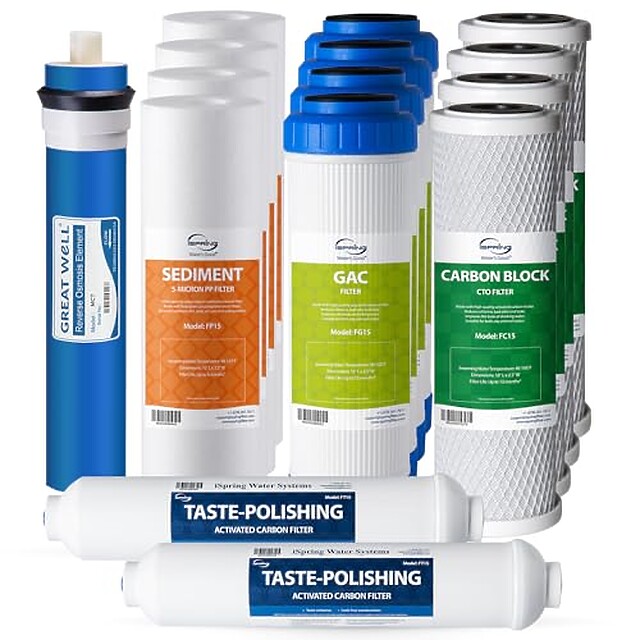 Ispring 5-Stage 75GPD Reverse Osmosis Filter Pack
 iSpring RCC7AK 6-Stage Alkaline RO System (75 GPD, with F9K Filter Pack)
 Ispring RCC2AK (200 GPD, 6-Stage Alkaline)
It is a reverse osmosis water filtration system that treats your supply in six steps before it reaches a dedicated drinking water tap. Three pre-filters clean the water, the membrane does the main purification, and two post-filters finish it off. The reverse osmosis membrane has pores of around 0.0001 microns: water passes through under pressure, while dissolved salts, heavy metals and most other contaminants are flushed to the drain.
The first five filters are the same on almost every water filter of this type. The sixth is where brands differ, so the number tells you how many filters there are, not what the last one does. Read the stage list before you buy.
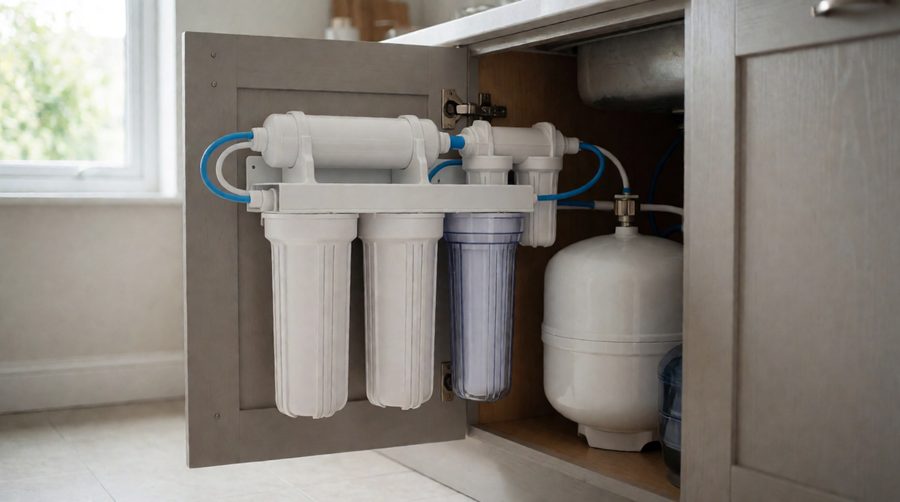
Each filter protects the one after it. This is the layout of the iSpring RCC7AK and the Applied Membranes AAA-ROPH-50, both in our range:
| Step | Filter | What it does | Typical change |
|---|---|---|---|
| 1 | 5 micron sediment filter | Traps sand, rust and silt that would clog the filters after it | 6-12 months |
| 2 | Granular activated carbon | Takes out chlorine, odour and organic chemicals | 6-12 months |
| 3 | Activated carbon block | Removes the last chlorine, which would damage the membrane | 6-12 months |
| 4 | RO membrane | Rejects most dissolved solids, including lead, fluoride, nitrate and limescale | 2-3 years |
| 5 | Post carbon | Polishes the taste of water leaving the storage tank | 12 months |
| 6 | Alkaline / mineral | Adds calcium and magnesium back and lifts the pH above 7 | 6-12 months |
The intervals come from iSpring's listing for the RCC7AK: pre-filters and the alkaline cartridge every 6-12 months, the membrane every 2-3 years. Very hard water or heavy use shortens them.
Look at the shops that sell these and you find three different sixth filters:
If you want both minerals and UV, that is a seven-filter kit: see our 7 stage reverse osmosis systems.
Reverse osmosis removes the good with the bad, so plain RO water has very little calcium or magnesium and many people find it flat. The Drinking Water Inspectorate (DWI) notes that the World Health Organization recommends adding minerals back when reverse osmosis water is used for drinking. That is exactly the job of the alkaline sixth filter, and the main reason to choose this reverse osmosis system over a five-filter one.
Every figure below comes from the manufacturer's listing in our product feed. GPD means US gallons per day under test conditions; one gallon is 3.785 litres, so 75 GPD is about 284 litres per day. Cold UK mains water flows a little slower.
| Model | Output | Power | Feed water | Sixth filter | Notes |
|---|---|---|---|---|---|
| iSpring RCC7AK | 75 GPD (~284 litres) | Mains pressure | 4-38°C | Alkaline | NSF/ANSI 58, 1-year warranty |
| iSpring RCC7P-AK | 75 GPD, up to 2 litres/min | Booster pump | 40-80 psi | Alkaline | 3.2 gallon tank, NSF/ANSI 58 |
| iSpring RCC2AK | 200 GPD (~757 litres) | Mains socket | Up to 500 ppm TDS | Alkaline | Top-mounted faucet, compact unit |
| NU Aqua Platinum | 100 GPD (~379 litres) | Mains pressure | - | Alkaline + trace minerals | PPM meter included, 3-year warranty |
| Viva21 V21RS6S01PH | 50 GPD (~189 litres) | Mains pressure | Up to 1,000 ppm | Alkaline | NSF/ANSI 58 & 372, leak detector |
| Applied Membranes AAA-ROPH-50 | 50 GPD | Adapter | Up to 500 ppm | Alkaline | Coconut carbon polisher, ~1 gallon tank |
| Max Water 6 Stage RODI 1 | 100 GPD | - | - | DI resin | 0 TDS for aquariums, inline TDS meter |

For the kitchen, pick an alkaline reverse osmosis system with a faucet and tank. For a fish tank, a RODI filtration system such as the Max Water gives the 0 TDS water marine tanks need, and usually has no faucet at all.
A non-pumped system relies on mains pressure. If yours is low, output falls and more goes to the drain, so choose a pumped system like the iSpring RCC7P-AK, which needs a socket under the sink. Our tankless RO systems also have built-in pumps.
Each system has a maximum total dissolved solids rating for the water going in: 500 ppm on the RCC2AK and Applied Membranes, 1,000 ppm on the Viva21. A cheap TDS pen shows where your tap water sits before it reaches the system. Hard water wears the membrane faster.
50 GPD is plenty for drinking and cooking for most families. 75-100 GPD refills the tank faster for bigger households, and 200 GPD suits heavy use. Remember the tank only holds a few litres of usable water.
NSF/ANSI 58 covers RO performance and NSF/ANSI 372 lead-free materials. Any water filter system plumbed into the mains in the UK must also meet the Water Supply (Water Fittings) Regulations 1999. The DWI's page on domestic water filters and softeners explains what to check.
Every reverse osmosis system sends some water away to flush out what the membrane rejects. The DWI puts this at 20-30% of the incoming flow and warns it can raise a metered water bill by up to a third. It also says that by law you must tell your water company before you fit one. Water Regs UK explains how notification works.
If waste matters, look at countertop reverse osmosis systems, which often run at 3:1 pure to drain, or a pumped system, as higher pressure means less goes down the drain.
Budget for cartridges before you buy a reverse osmosis system. A typical year looks like this:
A multi-filter pack works out cheaper than single cartridges. iSpring's F9K is a 1-year set for the RCC7AK, and the Kind Water Systems PRO-RO-R EU covers stages 1-6 for its PRO-RO for a year. Buy for your exact water filter, as housing sizes and fittings differ. Overdue filters can let deposits and bacteria build up, so stick to the schedule.
Most people with basic DIY skills can fit one in an afternoon. The kit connects to your cold supply and the sink waste:
The check valve stops water flowing backwards into the mains. Backflow protection is a legal requirement, set out in the WRAS installation requirements. If in doubt, use a plumber. Flush the first tank away before drinking. iSpring publishes installation videos for its kits.
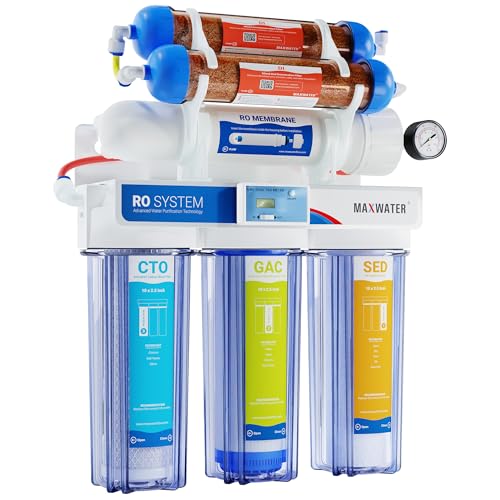
Usually sediment, granular carbon, carbon block, the RO membrane, a post carbon filter and an alkaline remineraliser. Some brands use a UV lamp or DI resin as the last filter instead.
Not at removing contaminants, as the membrane does that on both. The sixth filter adds minerals for a better taste and a higher pH. If you want pure low-TDS water for coffee or an aquarium, five is enough.
Pre-filters and the alkaline cartridge every 6-12 months, the post carbon yearly and the membrane every 2-3 years.
Only if it has a booster pump, a UV lamp or is a plug-in unit like the RCC2AK. Systems such as the RCC7AK, NU Aqua and Viva21 run on mains pressure alone.
The DWI says 20-30% of the incoming flow goes to the drain. Pumped systems waste less.
